Best CRM Software for Charities and Nonprofits in 2026
A detailed comparison of the best CRM platforms for UK charities in 2026, including Plinth, Salesforce Nonprofit, Beacon, Donorfy, ThankQ, and Bitrix24. Find the right fit for your organisation.
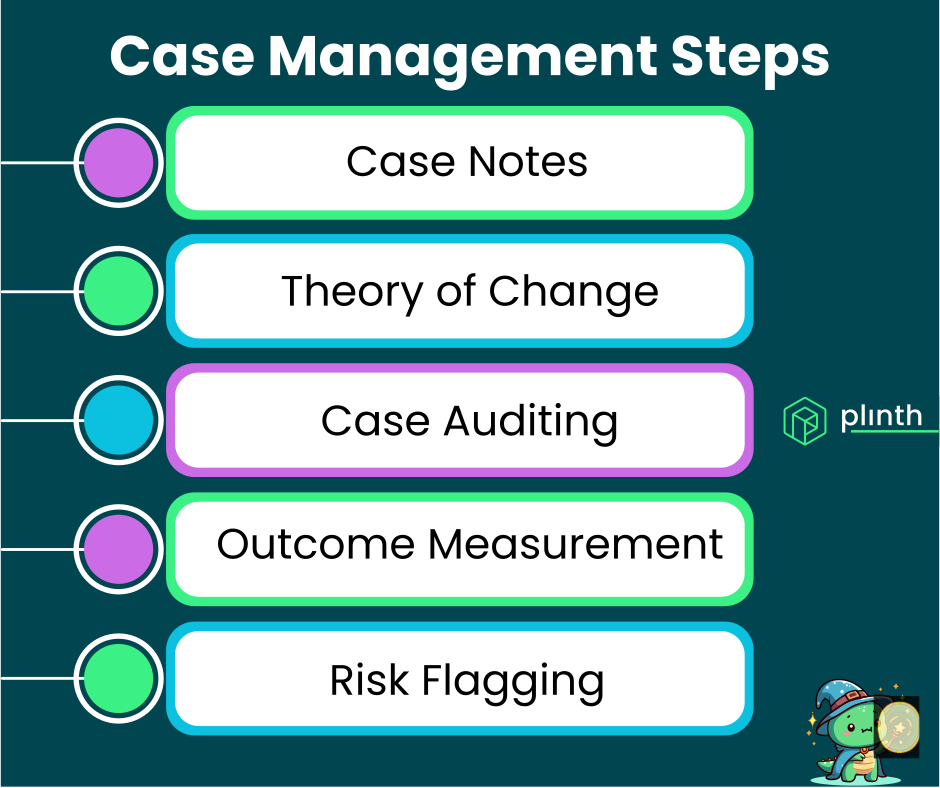
Choosing the right CRM can transform how your charity manages relationships, tracks referrals, and reports to funders. But with dozens of options on the market, finding the best fit for a nonprofit budget and workflow is harder than it should be. This guide compares six leading CRM platforms used by UK charities in 2026 and explains when each one makes sense.
Scope: This guide focuses on donor-focused and partner CRMs. If you need case management or referral-network tools as your primary use case, see our Charitylog alternatives and Lamplight alternatives comparisons, which cover the leading UK case-management CRMs in that category.
TL;DR: If you need to manage partner organisations and referral networks, Plinth is purpose-built for that. For donor-focused fundraising, Beacon and Donorfy are strong UK options. Salesforce Nonprofit is powerful but expensive to configure. ThankQ suits large legacy charities. Bitrix24 is a budget option but lacks sector focus.
What you'll learn: How six popular CRMs compare on price, features, ease of use, and suitability for UK charities.
Who this is for: Charity managers, fundraisers, and operations leads evaluating CRM platforms.
Why Charities Need a CRM in 2026
The charity sector has undergone rapid digital transformation. According to the 2025 Charity Digital Skills Report, 76% of UK charities now use AI tools (up from 61% in 2024), yet only 44% have a documented digital strategy. A significant proportion still rely on spreadsheets for contact and relationship management.
A CRM (Customer Relationship Management) system adapted for the charity sector helps organisations centralise contacts, track interactions, manage referrals, and demonstrate impact to funders. The right CRM reduces duplicate data entry, improves safeguarding, and gives leadership teams visibility over the relationships that matter most.
The cost of getting it wrong is real. Charities consistently report that significant staff time goes on administrative tasks that could be automated — poorly chosen software compounds this problem rather than solving it.
The Six CRMs Compared
Here is a summary comparison table before we look at each platform in detail.
| Feature | Plinth | Salesforce Nonprofit | Beacon | Donorfy | ThankQ | Bitrix24 |
|---|---|---|---|---|---|---|
| Built for UK charities | Yes | Partial | Yes | Yes | Yes | No |
| Partner/organisation CRM | Yes | Via customisation | No | No | No | No |
| Referral tracking | Yes | Via customisation | No | No | No | No |
| Donor management | Yes (relationship/major-donor) | Yes | Yes | Yes | Yes | No |
| Grant management | Yes | Via apps | No | No | No | No |
| Case management | Yes | Via customisation | No | No | No | No |
| Typical annual cost | From free | £2,000-£30,000+ | From ~£400 | Essentials free; Professional from ~£800+VAT | Quote-based | Free tier (unlimited users); paid from ~£40/mo |
| Setup complexity | Low | High | Low-Medium | Low | Medium-High | Medium |
| UK GDPR compliance | Built in | Configurable | Built in | Built in | Built in | Configurable |
| AI features | Yes | Yes (Einstein) | No | No | No | Limited |
1. Plinth — Best for Partner and Stakeholder Relationships
Plinth takes a different approach to most charity CRMs. Rather than focusing on individual donors, it is designed to manage relationships with partner organisations, local authorities, and service delivery networks.
What it does well:
- Partner directory with connected/not-connected status tracking
- Referral management with full lifecycle tracking (Pending, In Progress, Accepted, Completed, Rejected)
- Smart referral cascading — if one partner cannot help, the referral moves automatically to the next
- Coverage mapping with ward and LAD boundaries overlaid
- Embeddable service directory for council and partner websites
- Case management and grant management in the same platform
Pricing: Plinth offers accessible pricing for charities of different sizes, including a free tier for small organisations.
Best for: Charities that work with a network of partner organisations, infrastructure bodies, local authorities commissioning services, and organisations that need referral tracking alongside case or grant management.
Limitation: Plinth now includes donor management — a relationship-fundraising CRM with a cultivation/stewardship pipeline, AI donor research and prospecting, donation recording, Gift Aid tracking and reclaim management, and donor portals with live impact reports — and is strongest for major-donor, trust, and foundation relationships. But if your primary need is high-volume individual giving and recurring direct-debit campaigns with public online donation pages, consider pairing Plinth with a dedicated fundraising tool.
Most UK charities collaborate with other organisations in some form — through referral networks, consortia, or local partnerships — yet most CRMs are designed for donor relationships rather than partnership management.
2. Salesforce Nonprofit — Best for Large, Well-Resourced Charities
Salesforce Nonprofit Cloud — the successor product to NPSP (the Nonprofit Success Pack, which remains available but is no longer receiving new feature development) — is the enterprise option. It offers enormous flexibility through its platform approach, but that flexibility comes at a cost, both financial and operational.
What it does well:
- Highly customisable data model for complex organisational needs
- Large ecosystem of apps and integrations
- Einstein AI for predictive analytics and donor scoring
- Strong reporting and dashboard capabilities
- 10 free Enterprise Edition licences (Agentforce Nonprofit or Sales/Service Cloud) available to eligible nonprofits through the Power of Us programme
Pricing: While 10 licences are free, most charities need paid add-ons, implementation consultants, and ongoing admin support. Total cost of ownership typically ranges from £10,000 to £30,000+ annually for a mid-sized charity once you factor in implementation, customisation, and a part-time Salesforce administrator.
Best for: Large charities (50+ staff) with dedicated IT or operations capacity, complex donor journeys, and budget for professional implementation.
Limitation: Implementation timelines of 3-9 months are common. A common challenge with Salesforce in the charity sector is implementation complexity — without ongoing investment in configuration, the platform can become unwieldy.
Salesforce's annual Nonprofit Trends Report consistently finds that organisations using the platform see measurable gains in fundraising performance, but also that under-configured deployments leave significant functionality unused — making the configuration investment material to outcomes.
3. Beacon — Best for Small-to-Medium UK Fundraising Charities
Beacon is a UK-built CRM designed specifically for charity fundraising. It has gained significant traction since its launch, particularly among charities with income between £100,000 and £5 million.
What it does well:
- Clean, modern interface that staff find easy to learn
- Gift Aid processing and HMRC integration
- Event management and ticketing
- Email marketing built in
- Strong supporter segmentation
Pricing: Beacon's Starter plan begins at approximately £32.50 per month (around £390 annually) for up to 2,000 contacts, scaling with contact count and feature tier.
Best for: Fundraising-focused charities that want an all-in-one donor management and communications platform without Salesforce-level complexity.
Limitation: Beacon is focused on fundraising and supporter management. It does not offer partner CRM, referral tracking, case management, or grant management features. Charities needing those capabilities will need a second system.
4. Donorfy — Best Budget Option for Donor Management
Donorfy is another UK-built CRM aimed squarely at charity fundraising. It offers solid core features at a lower price point than Beacon.
What it does well:
- Donor management with giving history and pledges
- Gift Aid claims and HMRC integration
- Direct debit management (GoCardless integration)
- Basic reporting and segmentation
- Integrations with Mailchimp, JustGiving, and other fundraising platforms
Pricing: Donorfy Essentials is free for charities with up to 250 constituents. Donorfy Professional starts from approximately £59-£69 per month + VAT for larger charities, with pricing scaling by constituent count — making it one of the most affordable dedicated charity CRMs available.
Best for: Small charities focused primarily on individual giving who need a step up from spreadsheets without a large budget.
Limitation: Donorfy's reporting capabilities are more basic than Beacon or Salesforce. It is a donor CRM only — no partner management, referral tracking, or case management.
The Charities Aid Foundation reported that UK charitable giving reached approximately £15.4 billion in 2024 (up from £13.9bn in 2023). Despite this scale, a significant proportion of small charities still rely on spreadsheets rather than dedicated CRMs to manage those relationships.
5. ThankQ — Best for Legacy Charities with Complex Data
ThankQ (by Advanced) is a long-established charity CRM used by many large UK nonprofits, particularly those with complex legacy giving programmes and membership schemes.
What it does well:
- Comprehensive contact and organisation management
- Legacy and in-memoriam giving workflows
- Membership and subscription management
- Event and volunteer management modules
- Detailed financial reporting
Pricing: Quote-based, typically requiring a multi-year contract. Costs vary significantly based on modules selected and number of users. Expect to invest substantially in implementation.
Best for: Established charities with legacy giving programmes, membership schemes, and complex data migration needs where the organisation is already using Advanced products.
Limitation: The interface feels dated compared to modern cloud-native platforms. Implementation and customisation requires specialist consultants. ThankQ is less agile for organisations that want to move quickly.
6. Bitrix24 — Best Free General-Purpose Option
Bitrix24 is not a charity-specific CRM, but its generous free tier makes it attractive to very small organisations or those exploring CRM for the first time.
What it does well:
- Free tier supports unlimited users with core CRM features (5GB storage)
- Project management and task tracking
- Internal communications and team chat
- Basic contact management and deal tracking
- Website builder included
Pricing: Free plan supports unlimited users with 5GB storage. Paid plans start from approximately £40 per month for additional storage, automation, and advanced features.
Best for: Small or budget-constrained organisations exploring CRM that don't need charity-specific workflows, and are willing to adapt a commercial tool to nonprofit use.
Limitation: Bitrix24 is designed for commercial sales pipelines, not charity workflows. It lacks Gift Aid support, referral tracking, case management, grant management, and any UK charity-specific compliance features. The learning curve can be steep, and the interface is cluttered.
How to Choose: Decision Framework
Use these questions to narrow your shortlist.
What relationships are you managing?
- Partner organisations and referral networks → Plinth
- Individual donors and supporters → Beacon, Donorfy, or Salesforce
- Both → Plinth paired with a fundraising CRM
What is your budget?
- Under £500/year → Donorfy Essentials (free for small charities), Bitrix24 (free), or Beacon's Starter plan
- £500-£5,000/year → Beacon, Donorfy Professional, or Plinth
- £5,000+/year with IT capacity → Salesforce Nonprofit
How complex are your needs?
- Simple contact management → Donorfy
- Fundraising plus events and email → Beacon
- Partner networks, referrals, and case management → Plinth
- Highly customised enterprise workflows → Salesforce
Do you need UK-specific features?
- Gift Aid processing → Beacon, Donorfy, or ThankQ
- Charity Commission and Companies House checks → Plinth
- UK GDPR compliance built in → Plinth, Beacon, Donorfy, or ThankQ
According to the Charity Commission, there are around 170,000 registered charities in England and Wales (170,056 at 31 March 2024). The vast majority have fewer than 10 staff, making ease of use and affordable pricing critical selection criteria.
Common Mistakes When Choosing a Charity CRM
Buying a donor CRM when you need a partner CRM. Many charities default to fundraising CRMs because they are the most marketed. If your primary relationships are with partner organisations, councils, or service delivery networks, a donor CRM will not fit.
Underestimating total cost of ownership. The subscription fee is only part of the cost. Factor in implementation, data migration, training, and ongoing administration. Salesforce's free licences, for example, often lead to total costs exceeding those of paid alternatives.
Choosing features over usability. A CRM that staff do not use is worse than no CRM at all. Prioritise platforms that your team will actually adopt. Simpler tools with high adoption rates deliver more value than feature-rich platforms gathering dust.
Ignoring integration needs. Consider how the CRM will connect with your other tools — accounting software, email marketing platforms, grant management systems, and reporting dashboards.
Frequently Asked Questions
Can we use a free CRM for our charity?
Yes. Both Bitrix24 and Plinth offer free tiers, and Salesforce provides 10 free licences through the Power of Us programme. However, free does not mean zero cost — you will still invest staff time in setup, training, and maintenance. Evaluate whether the free tier genuinely meets your needs or whether you will quickly outgrow it.
Should we use one CRM for everything or multiple specialist tools?
There is no single correct answer. Charities managing both donor relationships and partner networks often benefit from two specialist tools rather than one compromised generalist. Plinth for partner and referral management alongside Beacon or Donorfy for fundraising is a common combination.
How long does CRM implementation take?
For cloud-based, purpose-built platforms like Plinth, Beacon, or Donorfy, expect 2-6 weeks. For Salesforce or ThankQ, expect 3-9 months depending on complexity. The biggest variable is usually data migration and staff training rather than technical setup.
What about data migration from spreadsheets?
Most modern CRMs support CSV import, making migration from spreadsheets straightforward. The harder part is cleaning your data before import — deduplicating contacts, standardising fields, and deciding what historical data to bring across. Budget time for this regardless of which CRM you choose.
Is Salesforce really free for charities?
Salesforce provides 10 free Enterprise Edition licences to eligible nonprofits through its Power of Us programme. However, most charities need additional paid products (Marketing Cloud, Experience Cloud), implementation support (typically £5,000-£15,000), and an ongoing administrator. The total cost of ownership is rarely free.
Do we need a CRM if we already have a grant management system?
If your grant management system handles funder relationships and compliance, you may not need a separate donor CRM. However, if you also manage partner organisations, referral networks, or wider stakeholder relationships, a Partner CRM adds value that grant systems do not provide.
Recommended Next Pages
How Do Charities Track Beneficiaries? — Methods for tracking the people you support, from spreadsheets to integrated platforms.
The Complete Guide to Partner CRM for Nonprofits — Understand what Partner CRM is and why it matters for charities working with networks.
Partner CRM vs Salesforce for Charities — A detailed head-to-head comparison of the two platforms.
How to Manage Stakeholder Relationships as a Charity — Practical guidance on relationship management beyond donors.
Charity CRM vs Grant Management System — Understand when you need one, the other, or both.
Last updated: May 2026
For more information about Plinth's Partner CRM, contact our team or schedule a demo.