Case Management for Housing Associations: Best Practices
A comprehensive guide to implementing effective case management in housing associations, covering resident support tracking, workflows, team coordination, and technology choices for community-focused housing providers.
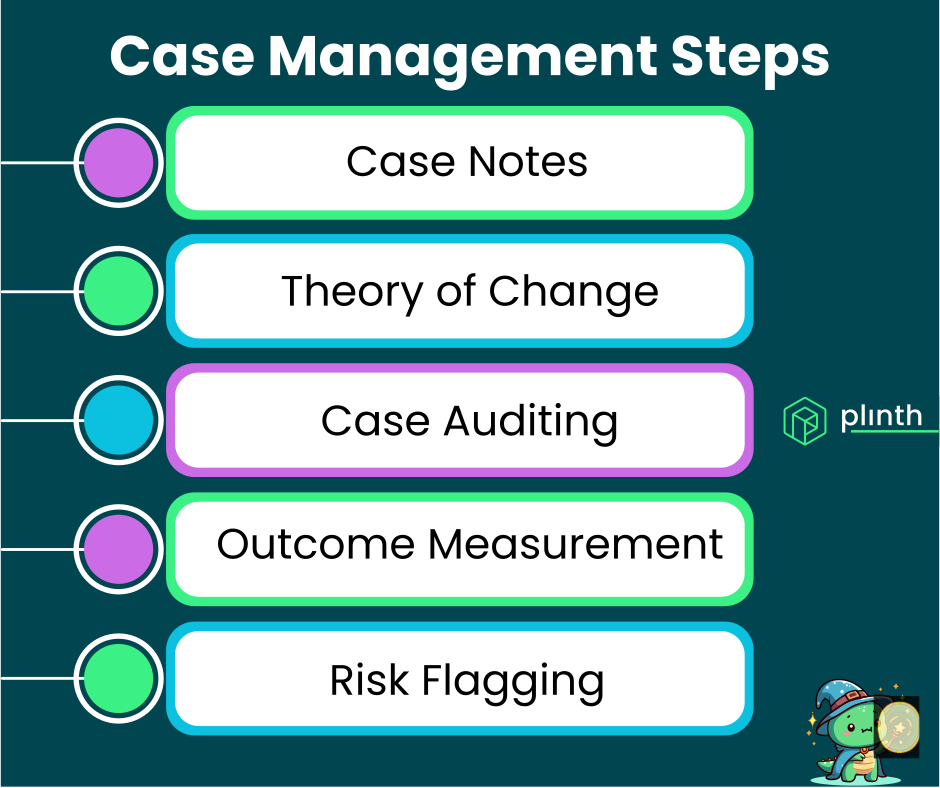
Housing associations are increasingly recognised not just as landlords but as anchor institutions that provide wide-ranging support to residents and communities. Managing that support effectively requires structured case management — the ability to track who you are helping, what support you are providing, and what outcomes are being achieved across employment programmes, financial inclusion, tenancy sustainment, community engagement, and more.
TL;DR: Housing associations that implement structured case management for community and resident support see better outcomes, stronger evidence for funders, and more efficient use of staff time. The key is choosing approaches and tools designed for housing contexts rather than adapting generic systems.
What you'll learn: Best practices for designing and implementing case management that fits the specific needs of housing associations.
Why it matters: With housing associations supporting an estimated 6 million residents across 2.9 million homes in England, the scale of resident support delivery demands systematic management.
Implementation focus: Practical recommendations you can apply whether you are starting from scratch or improving existing processes.
Who this is for: Tenancy support managers, community programme leads, and housing IT teams designing or improving case management processes.
Why Housing Associations Need Case Management
Housing associations deliver a breadth of services beyond core landlord functions. Employment and training programmes, debt and benefits advice, mental health support, digital inclusion, youth work, and community development all involve ongoing relationships with individual residents that need to be tracked, coordinated, and reported on.
The Scale of Support
The National Housing Federation estimates that housing associations invest significantly in communities. Much of this investment takes the form of one-to-one support services where individual case management is essential.
Employment Support: Housing associations collectively help thousands of residents into work each year, with programmes typically involving multiple touchpoints over several months.
Financial Inclusion: Debt advice, benefits maximisation, and budgeting support require careful tracking of individual progress and outcomes.
Tenancy Sustainment: Early intervention when residents show signs of struggling with their tenancy — arrears, complaints, disengagement — requires a case management approach to coordinate responses.
Wellbeing Services: Mental health, social isolation, and health improvement programmes need individual tracking to demonstrate effectiveness.
Without case management, these services operate in silos, staff lack visibility of each other's work, and the organisation cannot demonstrate the collective impact of its investment.
Common Challenges Without Structure
Housing associations that rely on informal or fragmented systems for tracking resident support face predictable problems.
Lost Information: When support interactions are recorded in individual notebooks, emails, or spreadsheets, information is lost when staff move on. Research suggests that significant case knowledge can be lost during staff transitions without proper handover systems.
Duplication: Multiple teams may work with the same resident without knowing about each other's involvement, leading to duplicated effort or contradictory advice.
No Outcomes Data: Without systematic recording, it becomes impossible to demonstrate what support was provided and what it achieved.
Inconsistent Follow-Up: Without reminders and tracking, follow-up actions are missed and residents experience unreliable support.
Safeguarding Risk: Inadequate records create safeguarding risks if concerns are not documented, shared, and escalated appropriately.
These challenges are not about individual staff failing — they are about organisational systems not being fit for purpose.
Designing Case Management for Housing Associations
Housing association case management has specific characteristics that distinguish it from case management in other sectors.
Define What Constitutes a Case
Not every resident interaction needs a case. Define clear criteria for when a case should be opened.
Threshold: Typically, a case is opened when a resident enters a structured support programme or when their situation requires coordinated, ongoing intervention rather than a one-off response.
Examples:
- Resident enrolled in an employment programme (case opened)
- Resident referred for debt advice (case opened)
- Resident identified as at risk of tenancy failure (case opened)
- Resident calling to report a repair (not a case — handled through repairs process)
- Resident attending a one-off community event (not a case — recorded as engagement)
Clarity: Ensure all staff understand the criteria so cases are created consistently.
Clear case criteria prevent both under-recording (missing cases that should be tracked) and over-recording (creating cases for routine interactions that do not require them).
Design Appropriate Workflows
Workflows should reflect the actual support journeys that residents follow through your services.
Programme-Based Workflows: Create workflows for each major programme or service type — employment support, financial inclusion, digital skills, tenancy sustainment, and so on.
Standard Stages: Each workflow should have defined stages that cases progress through, such as: Referral → Assessment → Active Support → Review → Closure.
Flexibility: Allow for variation within workflows. Not every resident's journey follows the same path, and case workers need discretion to adapt.
Cross-Programme Cases: Design for residents who participate in multiple programmes simultaneously. A resident might have an active employment case and a financial inclusion case — these should be linked but distinct.
| Workflow | Typical Duration | Key Stages | Primary Outcomes |
|---|---|---|---|
| Employment support | 3–12 months | Referral, skills assessment, job search, placement, in-work support | Employment, training qualification |
| Financial inclusion | 1–6 months | Referral, assessment, action plan, support sessions, review | Debt reduction, benefits maximised |
| Tenancy sustainment | Ongoing | Early warning, assessment, intervention, monitoring | Tenancy maintained, arrears reduced |
| Digital inclusion | 1–3 months | Assessment, training sessions, independent use | Digital skills gained, online access |
| Wellbeing support | 3–12 months | Referral, assessment, support plan, sessions, review | Wellbeing score improvement |
Workflows provide structure without rigidity — they guide practice while allowing professional judgement.
Establish Recording Standards
Consistent recording is the foundation of effective case management. Set clear standards that staff can realistically meet.
Timeliness: Notes should be recorded on the same day as the interaction. Same-day recording substantially improves accuracy compared to retrospective documentation.
Content Minimum: Every note should include: date, who was involved, what was discussed or done, any concerns raised, and agreed next steps.
Outcome Recording: Record outcomes as they are achieved, not just at case closure. If a resident gains a qualification in month three of a six-month programme, record it then.
Professional Language: Notes should be factual, respectful, and written with the awareness that the resident has the right to access their records under data protection law.
Use AI Where Possible: AI case notes can significantly reduce the documentation burden by transcribing and structuring notes from recorded conversations, freeing staff to focus on the resident rather than the paperwork.
Standards should be high enough to be useful but realistic enough to be maintained consistently.
Team Coordination and Workflows
Housing associations typically have multiple teams and individuals supporting the same residents, making coordination essential.
Cross-Team Visibility
Ensure that all teams working with a resident can see relevant information about that resident's engagement with other services.
Shared Records: Use a centralised case management system that gives appropriate visibility across teams.
Permission Controls: Not all information should be visible to everyone. Configure access so that sensitive information is restricted to those who need it, while general engagement data is shared.
Alerts: Set up notifications when a new case is opened for a resident who already has an active case with another team.
Multi-Agency Working: Where housing associations work with external partners (local authorities, health services, voluntary organisations), agree information sharing protocols and consider shared case records where appropriate.
Visibility prevents duplication and enables coordinated support — but must be balanced with data protection and confidentiality.
Supervision and Quality Assurance
Regular supervision supports case workers to deliver high-quality support and ensures organisational oversight.
Caseload Review: Supervisors should regularly review each case worker's caseload, checking progress, identifying stuck cases, and ensuring appropriate prioritisation.
Case Audits: Periodically audit a sample of cases for recording quality, appropriate actions, and outcome documentation.
Concern Levels: Use concern levels (low, medium, high) to prioritise supervision discussions and ensure the most complex cases receive adequate oversight. Approximately 70% of cases typically sit at low concern, 20% at medium, and 10% at high — but this varies by programme.
Reflective Practice: Create space for case workers to reflect on their practice, discuss challenging cases, and learn from each other.
Good supervision improves both outcomes for residents and retention of staff.
Managing Referrals
Housing associations both receive and make referrals, and effective referral management is a critical part of case management.
Internal Referrals: Make it easy for staff to refer residents between programmes. A tenancy officer who identifies a resident struggling financially should be able to refer easily to the financial inclusion team.
External Referrals: Track referrals made to external agencies, including whether the resident engaged with the referred service and the outcome.
Referral Criteria: Publish clear referral criteria for each programme so colleagues and partners know when a referral is appropriate.
Feedback Loops: Ensure referrers receive feedback on the outcome of their referral, encouraging continued appropriate referrals.
Smooth referral pathways mean residents get the right support quickly without navigating organisational complexity themselves.
Technology Choices
The right technology makes case management significantly more effective, but the wrong choice can create additional problems.
What to Look For
Housing associations should evaluate case management software against criteria specific to their needs.
Sector Understanding: Software designed for or adaptable to housing and community contexts will require less customisation than generic tools.
Ease of Use: Front-line staff need intuitive systems. The majority of software implementations that fail do so because of poor user adoption rather than technical problems.
Mobile Access: Community-based staff need mobile access to record notes and check case information in the field.
Reporting: Built-in reporting that supports TSM reporting, funder requirements, and social value calculation saves significant manual effort.
Integration: The ability to integrate with or import data from existing housing management systems avoids double entry.
AI Capabilities: Features like AI case notes and AI-powered summaries reduce administrative burden and improve data quality.
Choose software that works for your front-line staff, not just your IT team.
Purpose-Built vs Generic Tools
Housing associations often face a choice between purpose-built community software and generic CRM or project management tools. See our detailed comparison guide for a full analysis.
Purpose-Built Advantages: Pre-configured for housing contexts, includes relevant outcome frameworks, understands multi-programme structures, and provides sector-relevant reporting.
Generic Tool Risks: Extensive customisation required, workflows do not fit housing contexts, reporting requires manual workarounds, and ongoing maintenance is higher.
The total cost of ownership for a purpose-built tool is often lower than a heavily customised generic system.
Measuring and Reporting Outcomes
Case management provides the data foundation for impact reporting. Without good case data, impact reports rely on estimates and anecdotes.
Individual Outcomes
Track outcomes at the individual level and aggregate for reporting.
Outcome Categories: Define the outcomes each programme is designed to achieve and record them systematically.
Distance Travelled: For longer programmes, measure progress against starting points to capture partial as well as complete outcomes.
Sustained Outcomes: Where possible, follow up to check whether outcomes are sustained over time.
Individual outcome data is the raw material for compelling impact reports.
Programme-Level Reporting
Aggregate individual data to programme level for management and funder reporting.
Outputs: Number of residents engaged, sessions delivered, referrals made.
Outcomes: Number and percentage of residents achieving defined outcomes.
Cost-Per-Outcome: Divide programme cost by outcomes achieved to demonstrate value for money.
Social Value: Apply HACT Social Value Bank values to quantify impact in monetary terms. Well-run programmes typically generate between £3 and £8 of social value for every £1 invested.
Programme-level reporting demonstrates whether investments are delivering expected returns.
Organisational-Level Reporting
Roll up programme data to provide an organisational view of community impact.
Total Investment: Aggregate all community investment including staff time, programme costs, and overheads.
Total Social Value: Sum social value across all programmes for a headline figure.
TSM Alignment: Connect community programme outcomes to TSM scores to demonstrate how investment supports resident satisfaction.
Trend Analysis: Track metrics over time to identify improvement or deterioration trends.
Organisational-level reporting informs board strategy and regulatory submissions.
Frequently Asked Questions
How does case management for housing associations differ from generic case management?
Housing association case management typically involves multiple concurrent programmes, cross-team working, integration with tenancy and housing management functions, and reporting requirements specific to the social housing sector (TSMs, social value, funder reports). Generic case management tools often lack these features, requiring extensive customisation. Purpose-built tools like Plinth are designed with these requirements in mind.
How many cases can one community worker manage effectively?
This depends on the complexity and intensity of the programme. For intensive employment support, a caseload of 25–35 active cases per full-time worker is typical. For lighter-touch programmes like digital inclusion, 40–60 may be manageable. For tenancy sustainment, where intervention intensity varies, 30–50 is common. The key is matching caseload to the time required per case rather than applying a single number.
Should we track all resident interactions or just programme-based support?
Track programme-based support through formal case management. Record broader engagement activities (events, community meetings, drop-ins) separately as engagement data rather than individual cases. The distinction matters because case management involves individual tracking, goals, and outcomes, while engagement tracking captures participation and reach. Both are valuable but serve different purposes.
How do we handle data protection for case management records?
Housing associations must comply with the UK GDPR and Data Protection Act 2018. Key considerations include: having a lawful basis for processing (typically legitimate interests or performance of a task in the public interest); providing clear privacy notices to residents; enabling subject access requests; implementing appropriate security measures; and defining data retention periods. Purpose-built case management software should support GDPR compliance through built-in access controls, audit trails, and data management features.
How do we get buy-in from housing management colleagues?
Connect case management to outcomes that matter across the organisation. Show how resident support programmes reduce rent arrears, lower void rates, decrease anti-social behaviour, and improve TSM scores. Use case studies and data from your reporting to demonstrate the business case. Involve housing management colleagues in designing referral pathways so they see the system as helpful rather than additional work.
Recommended Next Pages
The Complete Guide to Community Engagement for Housing Associations – Engagement strategies that feed into effective case management.
How Housing Associations Can Report on Community Impact – Turn case management data into compelling impact reports.
Housing Association Community Software vs Generic CRM – Choosing the right technology for your case management needs.
Case Management Best Practices for Nonprofits – General case management best practices applicable across sectors.
Housing Associations – How Plinth supports housing associations with case management and impact reporting.
Last updated: February 2026
For more information about case management for housing associations, contact our team or schedule a demo.