Housing Association Community Software vs Generic CRM: Which Is Better?
A detailed comparison of purpose-built community software and generic CRM platforms for housing associations, covering features, costs, implementation, and long-term value for resident support and impact reporting.
On this page9
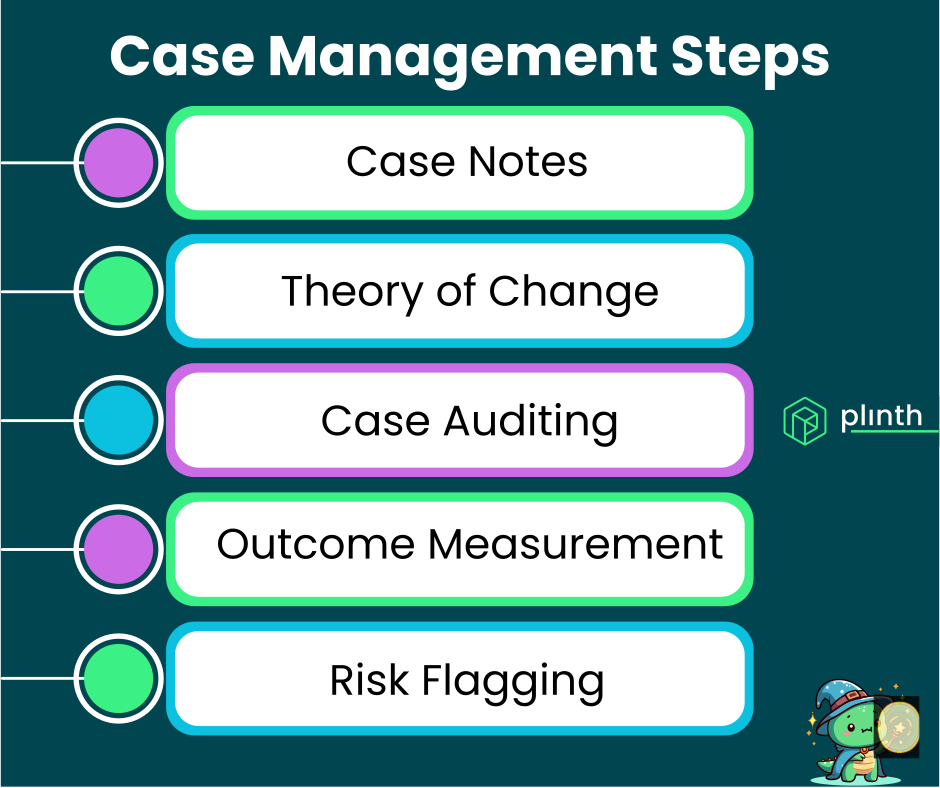
When housing associations need to track resident support, manage community programmes, and report on impact, they face a fundamental technology choice: use a purpose-built community platform designed for the sector, or adapt a generic CRM (Customer Relationship Management) system like Salesforce, Microsoft Dynamics, or HubSpot. Both approaches have advocates, and the right answer depends on your specific circumstances. This guide provides a thorough comparison to help you decide.
TL;DR: Purpose-built community software typically delivers faster implementation, lower total cost of ownership, and better outcomes for housing associations managing resident support programmes. Generic CRMs offer greater flexibility but require significant customisation, specialist skills, and higher ongoing maintenance to serve housing association needs effectively.
What you'll learn: A feature-by-feature comparison, cost analysis, implementation considerations, and practical guidance for making the right choice.
Who this is for: IT directors, community investment managers, and procurement leads at housing associations evaluating software options.
The Core Differences
Before examining specific features, it is important to understand the fundamental difference in approach between these two categories of software.
Purpose-Built Community Software
Software designed specifically for organisations that manage community programmes, resident support, and social impact — such as Plinth.
Pre-Configured: Comes with workflows, data structures, and reporting designed for community programme delivery. Typical implementation time is 2–6 weeks.
Sector Knowledge: Built by teams that understand housing association contexts, including multi-programme structures, outcome tracking, social value calculation, and funder reporting requirements.
Focused: Does one thing well — managing cases, tracking outcomes, and reporting impact — rather than trying to be everything to everyone.
Evolving with the Sector: Product development is driven by the needs of housing associations and similar organisations, so new features tend to be directly relevant.
Generic CRM
Broad platforms designed to manage customer relationships across any industry, from sales pipelines to support tickets.
Flexible: Can be configured to do almost anything, given sufficient time, budget, and technical expertise.
Widely Adopted: Large user communities, extensive documentation, and many integration options.
Enterprise-Grade: Built for large-scale deployments with sophisticated permission models, API access, and customisation capabilities.
Generalist: Not designed for any specific sector, so housing association requirements must be built from scratch or approximated.
The fundamental trade-off is between getting a tool designed for your needs versus building what you need on a more flexible platform.
Feature-by-Feature Comparison
The following comparison reflects typical capabilities out of the box. Generic CRMs can often match purpose-built features through customisation, but this adds time and cost.
| Feature | Purpose-Built (e.g. Plinth) | Generic CRM (e.g. Salesforce) |
|---|---|---|
| Case management | Pre-configured for support cases with concern levels, workflows, and outcome tracking | Requires custom objects and workflow configuration |
| Programme workflows | Built-in support for multiple concurrent programmes per resident | Must be custom-built; complex to manage multiple pathways |
| Outcome tracking | Pre-defined outcome frameworks aligned with sector standards | Must be custom-built from scratch |
| Social value calculation | Integrated or easily connected to HACT Social Value Bank | Requires custom development or manual calculation |
| Funder reporting | Built-in templates for common funder report formats | Must be custom-built; typically requires developer support |
| TSM alignment | Designed with regulatory requirements in mind | No awareness of housing sector regulations |
| AI case notes | Built-in speech-to-text and AI structuring | Requires third-party integration and custom development |
| Mobile access | Mobile-optimised for community-based staff | Available but may require additional licensing |
| Impact dashboards | Pre-built dashboards for community programme metrics | Must be custom-built; often requires specialist tools |
| Onboarding time | 2–6 weeks typical | 3–12 months for full housing association configuration |
| Training requirement | Minimal; designed for non-technical front-line staff | Significant; platform complexity requires extensive training |
Purpose-built software delivers more relevant functionality faster, while generic CRMs offer more flexibility at the cost of time and complexity.
Cost Comparison
Cost is often cited as the primary factor in software decisions, but housing associations frequently underestimate the total cost of ownership for generic CRMs.
Upfront Costs
Purpose-Built Software: Typically subscription-based with straightforward per-user or per-organisation pricing. Setup costs are lower because the system is pre-configured for the use case. Expect £200–£800 per month depending on organisation size and features, with minimal setup fees.
Generic CRM: Per-user licensing fees that appear comparable (£20–£300 per user per month depending on edition), but substantial additional costs for customisation, configuration, and data migration. Initial setup projects for housing association configurations typically cost £15,000–£75,000 with an external implementation partner.
Ongoing Costs
Purpose-Built Software: Subscription covers updates and new features relevant to your use case. Minimal ongoing technical maintenance required. Staff training is straightforward.
Generic CRM: Ongoing costs include: CRM administrator salary or contractor (£30,000–£50,000+ per year); periodic reconfiguration as requirements change; third-party app subscriptions for features not included in the core platform; and specialist consultant fees for complex changes.
Total Cost of Ownership (5-Year Estimate)
| Cost Component | Purpose-Built | Generic CRM |
|---|---|---|
| Licensing / subscription | £12,000–£48,000 | £24,000–£180,000 |
| Initial setup / customisation | £0–£5,000 | £15,000–£75,000 |
| Ongoing administration | £0–£5,000 | £50,000–£150,000 |
| Training | £1,000–£3,000 | £5,000–£20,000 |
| Third-party integrations | £0–£5,000 | £5,000–£25,000 |
| 5-year total | £13,000–£66,000 | £99,000–£450,000 |
The licensing cost of a generic CRM is often the smallest part of the total investment. Implementation, administration, and customisation typically account for 60–80% of total cost of ownership.
Implementation and Adoption
How quickly you can get a system working and how readily staff adopt it are critical success factors.
Time to Value
Purpose-Built Software: Most housing associations can be operational within 2–6 weeks. Pre-configured workflows mean you spend implementation time on adapting to your specific programmes rather than building basic functionality. Staff can begin recording cases and tracking outcomes almost immediately.
Generic CRM: A full housing association implementation typically takes 3–12 months. This includes requirements gathering, custom development, testing, data migration, and training. During this period, staff continue using existing (often manual) processes, delaying the benefits of the new system.
Research across the technology sector suggests that a majority of CRM implementations exceed their planned timeline and budget. This risk is significantly lower with purpose-built tools because less customisation is required.
Staff Adoption
The most important factor in any software implementation is whether staff actually use it.
Purpose-Built Software: Designed for the workflow of community and support workers, with interfaces that make sense for recording cases, logging interactions, and tracking outcomes. Staff see the system as a tool that helps them do their job rather than an administrative burden.
Generic CRM: Interface designed for sales or customer service workflows. Adapting it for community support requires significant UX compromise. Staff often find the system counter-intuitive, leading to low adoption, workarounds, and data quality issues.
Adoption Statistics: Industry data suggests that CRM user adoption rates vary widely across sectors, with many implementations failing to achieve full adoption. Purpose-built tools designed for specific sectors tend to achieve higher adoption rates due to lower complexity and more relevant workflows.
A system that 80% of staff use consistently is dramatically more valuable than a theoretically superior system that only 40% use.
Training Requirements
Purpose-Built Software: Typically requires 1–2 hours of initial training per user, with ongoing support for new features. Non-technical staff can usually become proficient within a week.
Generic CRM: Requires 4–8 hours of initial training per user at minimum, with additional training for administrators and report builders. Ongoing training is needed as custom features are added or modified.
Training costs include not just delivery but also the opportunity cost of staff time away from direct work with residents.
When a Generic CRM Might Be Right
Despite the advantages of purpose-built software, there are scenarios where a generic CRM may be the better choice.
Enterprise-Wide Platform
If your housing association has already invested heavily in a CRM for other functions (sales, lettings, customer service) and wants a single platform for all data, extending it to community programmes may make sense — provided you budget adequately for customisation and ongoing administration.
Highly Complex Requirements
If your requirements are genuinely unique and cannot be met by any purpose-built tool, a flexible platform allows you to build exactly what you need. However, ensure this need is real rather than assumed — most housing associations' community programme needs are more similar than different.
Technical Capacity
If your organisation has dedicated CRM administrators and developers who can build and maintain custom configurations, the ongoing cost and risk of a generic CRM is more manageable.
Integration Requirements
If deep integration with other enterprise systems (ERP, housing management, HR) is a primary requirement, a major CRM platform may offer more integration options out of the box.
Before choosing a generic CRM, honestly assess whether you have the budget, technical capacity, and organisational patience for the implementation journey.
When Purpose-Built Software Is the Better Choice
Focused on Community Impact
If your primary need is tracking resident support, managing community programmes, and reporting on social impact, purpose-built software delivers this faster and at lower cost.
Limited Technical Resources
If you do not have dedicated CRM administrators or an in-house development team, purpose-built software requires far less technical expertise to maintain.
Speed Matters
If you need to be operational quickly — perhaps to meet a funder's reporting deadline or respond to regulatory requirements — purpose-built software's faster implementation is a significant advantage.
Budget Constraints
If your budget is limited, purpose-built software's lower total cost of ownership makes it accessible to housing associations that could not afford a full CRM implementation.
Front-Line Staff Focus
If your priority is getting community workers and support staff to record and use data effectively, purpose-built software's intuitive design supports better adoption.
For most housing associations managing community programmes, purpose-built software is the right choice. The exceptions are organisations with enterprise-wide CRM strategies and the technical resources to support them.
Migration Considerations
If you are currently using a generic CRM and considering a move to purpose-built software, or vice versa, plan carefully.
Moving from Spreadsheets to Software
Many housing associations still track community programmes in spreadsheets. Moving to any software system — purpose-built or generic — represents a significant improvement. Key considerations:
Data Cleanup: Spreadsheet data often has inconsistencies that must be resolved before migration.
Process Definition: Moving to software forces you to define processes that may currently be informal, which is valuable but takes time.
Quick Wins: With purpose-built software, you can typically migrate core data and be operational within weeks.
Moving from Generic CRM to Purpose-Built
If you have invested in a CRM but are not achieving the expected benefits:
Assess Honestly: Is the problem the platform or the implementation? Sometimes fixing the existing system is more practical than replacing it.
Data Migration: Export your data and map it to the new system's structure. Purpose-built tools designed for housing contexts usually map well to existing data.
Parallel Running: Consider running both systems briefly to verify data accuracy before decommissioning the old system.
Staff Relief: Staff who have struggled with an ill-fitting CRM often welcome purpose-built tools enthusiastically, improving adoption.
Frequently Asked Questions
Can Salesforce be configured for housing association community programmes?
Yes, Salesforce can be configured for almost any use case, including housing association community programmes. The question is whether it should be. Configuration requires a skilled Salesforce administrator or consultant, typically costs £20,000–£50,000 for initial setup, and needs ongoing maintenance. If your organisation already uses Salesforce for other functions and has dedicated administrative resource, extending it may make sense. Otherwise, purpose-built software offers a faster, cheaper, and more effective route to the same outcomes.
What about Microsoft Dynamics?
Similar considerations apply to Dynamics as to Salesforce. It is a powerful, flexible platform that can be configured for housing association needs, but requires significant investment in customisation and ongoing administration. The licensing model can also become expensive when multiple community workers need access. Evaluate it against the same criteria: total cost of ownership, implementation time, staff adoption likelihood, and ongoing maintenance requirements.
Is it worth switching if we already have a CRM?
This depends on how well your current system serves your needs. If staff are actively using it, data quality is good, and you can produce the reports you need, switching may not be justified. If adoption is low, data quality is poor, or you cannot report on outcomes effectively, the investment in switching is likely to pay for itself through better data, higher adoption, and reduced administration time. Calculate the ongoing cost of your current system (including administration and workarounds) and compare it with the cost of a purpose-built alternative.
How do we evaluate purpose-built software options?
Focus on: sector relevance (does the vendor understand housing associations?); ease of use (will front-line staff actually use it?); reporting capabilities (can it produce the reports you need for funders, boards, and regulators?); implementation support (what help is provided during setup?); ongoing development (is the product actively improved?); and references (can you speak to similar housing associations using the tool?). Plinth is designed specifically for organisations managing community programmes and can demonstrate each of these criteria.
Can we start with purpose-built software and move to a CRM later?
Yes. Starting with purpose-built software gets you operational quickly and builds the data and processes you need. If your requirements later grow to need an enterprise CRM, you can migrate with the benefit of clean, well-structured data and clearly defined processes. This approach is often lower risk than starting with a CRM and hoping you can configure it to meet your needs.
Recommended Next Pages
Case Management for Housing Associations: Best Practices – Best practices for structuring resident support regardless of technology choice.
The Complete Guide to Community Engagement for Housing Associations – Engagement strategies that technology should support.
How Housing Associations Can Report on Community Impact – Reporting requirements that should inform your technology choice.
Case Management Software for Charities – Broader comparison of case management tools for the charity sector.
Housing Associations – How Plinth supports housing associations with purpose-built community software.
Last updated: February 2026
For more information about choosing the right software for your housing association, contact our team or schedule a demo.