Multi-Agency Case Management: Coordinating Support Across Services
How charities and local authority teams can coordinate case management effectively across multiple agencies and services. Practical guidance on information sharing, joint working, and avoiding duplication.
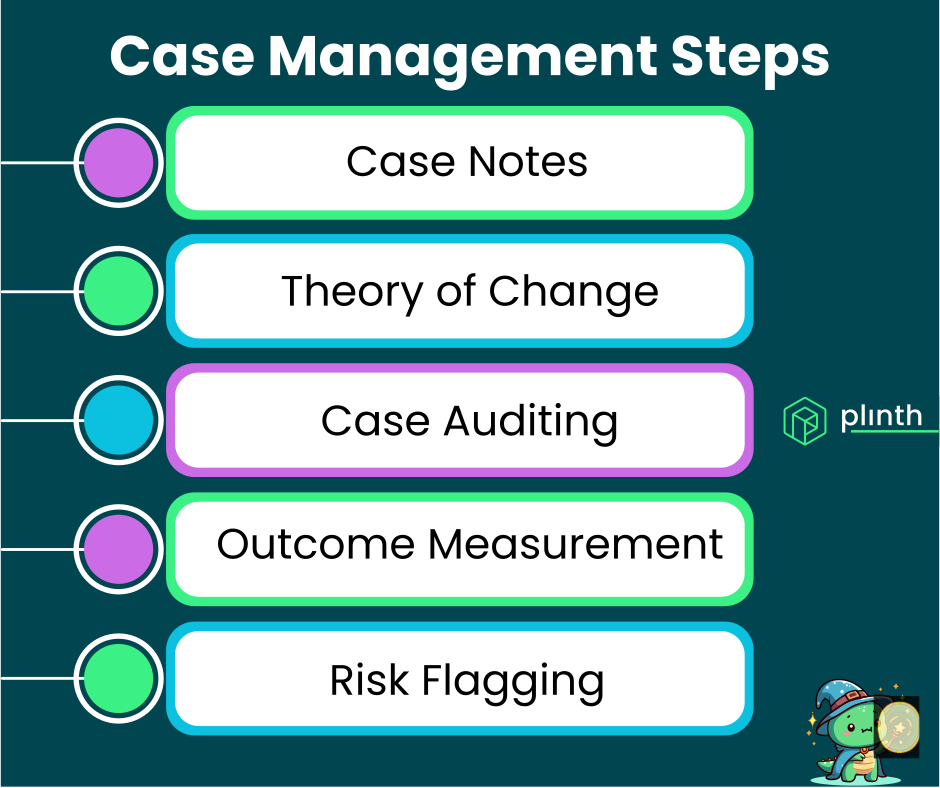
Most of the people who need case management support are not being supported by just one organisation. They are connected to housing services, mental health teams, employment support, community organisations, and statutory social care — often simultaneously, sometimes without any of those services knowing what the others are doing.
Effective multi-agency case management is about breaking that fragmentation. It means different services sharing relevant information, coordinating their actions, and acting as a coherent system of support rather than a collection of unconnected contacts.
What you'll learn: The principles and practice of multi-agency case management, the common barriers to effective joint working, and how your case management system can support coordination without creating compliance risk.
Why it matters: Fragmented support is less effective, more expensive, and more dangerous than coordinated support. The most serious safeguarding failures have almost always involved agencies who had information that, combined, would have indicated serious risk — but which were never seen together.
What Multi-Agency Case Management Means in Practice
Multi-agency case management does not mean all agencies using the same system. It means having a shared understanding of a case, clear roles and responsibilities, and mechanisms for communication that do not rely on chance.
The Coordination Challenge
Multiple Records, No Single Picture: A service user may have a case open with a housing charity, a mental health team, a food bank, and a social worker — with no one knowing the full picture.
Duplication: Different services may be doing the same assessment, asking the same questions, and providing overlapping support — wasting limited resources and creating confusion for the service user.
Gaps: Equally, services may each assume that another is covering a particular need. The gaps between organisations can be as dangerous as the duplication.
Information Lag: Referrals are made but not followed up. Services do not always know whether their referral was received, accepted, or acted on.
The Lead Professional Model
In many prevention and early intervention contexts, a single "lead professional" coordinates multi-agency working around an individual or family.
Clear Accountability: One professional is named as the coordinator — the person who holds the overall picture and ensures that the different services are working coherently.
Shared Planning: Multi-agency team around the family (TAF) meetings or similar structures bring key professionals together to agree a shared plan.
Communication Hub: The lead professional is the communication hub — receiving updates from other agencies and coordinating responses.
Good case management practice supports the lead professional model by providing a clear record of all contacts, referrals, and agreements.
Information Sharing in Multi-Agency Contexts
The most complex practical challenge in multi-agency case management is information sharing — knowing what can be shared, with whom, and how.
The Legal Framework
Information sharing in multi-agency contexts is governed by UK GDPR, the Data Protection Act 2018, and sector-specific guidance (such as Working Together to Safeguard Children and the Care Act 2014 guidance for adult services).
Lawful Basis: Sharing personal data requires a lawful basis. In multi-agency social care and safeguarding contexts, legitimate interests or vital interests may provide the basis, but this should be considered case by case and documented.
Data Minimisation: Share only the information necessary for the receiving organisation to fulfil its role in the case, not everything you know about the person.
Service User Consent: Where possible, involve the service user in decisions about what is shared with other agencies and keep them informed.
Information Sharing Agreements: Formal multi-agency partnerships should have information sharing agreements in place that set out the lawful basis, scope, and governance of information sharing.
Plinth's access control and audit trail features support GDPR-compliant information management within your organisation. For sharing with other organisations, appropriate agreements should be in place.
Practical Information Sharing
What Can Be Shared: Relevant factual information about the service user's situation, risk indicators, and what support your organisation is providing.
What Requires Consent: Information shared in confidence, particularly sensitive categories of data (mental health, sexual orientation, immigration status), requires explicit consent unless there is a safeguarding justification.
Recording Sharing Decisions: Document when information is shared with another agency, what was shared, the legal basis, and the recipient. This is both good practice and a data protection requirement.
Secure Channels: Information should be shared through secure channels — not personal email, consumer messaging apps, or other channels without appropriate security.
Recording Multi-Agency Activity in Case Notes
Good case management records should reflect the multi-agency nature of a case, not just the activities of your own organisation.
What to Record
Referrals Made: When you refer a service user to another agency, record the date, the agency, the reason, and the outcome. Did they receive a service? Were they accepted? What was the result?
Referrals Received: Record when another agency refers someone to you, including any information shared about the person's situation and what you are being asked to provide.
Joint Working Contacts: Record conversations with other agencies about a shared case — even brief ones. If a social worker calls to discuss a mutual client, note what was said and agreed.
Multi-Agency Meetings: Document attendance at case conferences, TAF meetings, MARACs, and other formal multi-agency processes — including who attended, what was discussed, and what was agreed.
Outcomes of Referrals: Close the loop — record what happened as a result of referrals and joint working activities.
Plinth's interaction tracking allows all of this to be recorded in the case timeline, giving a complete picture of all activity including multi-agency involvement.
Practical Coordination Mechanisms
Good coordination requires structures and habits, not just good intentions.
Team Around the Family/Individual
The team around the family (TAF) or team around the individual is a multi-agency structure designed to coordinate support for complex cases.
Core Elements: Named lead professional, shared assessment, agreed support plan, regular review meetings with all key professionals.
Who Should Attend: The professionals most directly involved in the case, plus the service user and (where appropriate) family members.
What Should Be Agreed: The plan that comes out of a TAF should be specific — who is doing what, by when, and how it will be reviewed.
Recording TAF agreements in the case management system ensures they are not forgotten and provides evidence of planned, coordinated support.
Regular Communication Protocols
For ongoing multi-agency cases, clear protocols for communication prevent information falling through the gaps.
Agreed Contact Points: Identify the key contact in each agency and how you will communicate — by email, by phone, at joint meetings.
Update Frequency: For high-concern cases, agree how frequently you will share updates with other agencies, and what triggers an immediate contact.
Handover Processes: When one agency closes its involvement, agree how the remaining agencies will be informed and what information will be shared.
Dealing With Disagreements in Multi-Agency Teams
Disagreements about risk assessment, appropriate responses, or roles and responsibilities are common in multi-agency work.
Escalate Professionally: If you believe another agency is not responding appropriately to a risk, escalate within your own organisation first. Do not just accept a response you believe is inadequate.
Document Disagreements: If you disagree with another agency's assessment or decision, record your concern in your own case notes even if you cannot change the other agency's position.
The Override Question: If you believe a service user is at risk of serious harm and another agency is not acting, your safeguarding duty may require you to act independently — including making a direct referral to statutory services.
Using Technology to Support Multi-Agency Working
Case management technology can reduce the friction of multi-agency working without creating compliance risk.
What Your System Should Do
Record Multi-Agency Activity Clearly: All referrals, joint contacts, and multi-agency meeting outcomes should be recordable as distinct types of interaction within the case record.
Support Handover: When a case is transferred to a new worker or when a case is closed and information needs to be shared with another agency, the system should make it easy to generate a comprehensive case summary.
AI-Supported Review: Plinth's AI analysis can generate a structured summary of a case's multi-agency history — including referrals made, responses received, and the current state of multi-agency involvement — that would otherwise require extensive manual review.
Secure Export: When information needs to be formally shared with another agency, the system should support secure export in appropriate formats.
What Technology Cannot Do
Technology cannot replace the relationships, communication habits, and professional judgment that make multi-agency working effective. The best case management system in the world will not prevent a safeguarding failure if the people involved are not communicating well.
Technology reduces friction; relationships and culture create effectiveness.
Frequently Asked Questions
Do all agencies working with a service user need to use the same case management system?
No — and it is rarely practical. Most multi-agency working involves organisations using their own systems and sharing information through agreed processes.
What Is Needed: Clear information sharing agreements, consistent recording of multi-agency contacts within your own system, and reliable communication channels with other agencies.
Shared Systems: In some partnership arrangements, a shared system may be agreed. This requires careful governance, clear data ownership, and appropriate access controls.
How do we handle a service user who does not want information shared?
Service users' wishes about information sharing should be respected where possible. Where there is a safeguarding concern, there may be a legal basis to share information without consent — but this should be documented carefully.
Transparency: Service users should be told at the start of support what information may be shared and with whom, as part of your data protection obligations.
The Safety Exception: The safety of a service user or others can override confidentiality in serious cases. This threshold is high and decisions should be made with supervisor involvement.
Who is responsible if things go wrong in a multi-agency context?
Each agency remains responsible for its own actions and omissions. Multi-agency working does not dilute individual organisational responsibility for appropriate practice.
Contributory Factors: Serious case reviews consistently identify situations where individual organisations acted appropriately within their own remit, but the system as a whole failed because of coordination breakdown.
Robust recording of multi-agency activity is your organisation's evidence that it acted appropriately.
Recommended Next Pages
Information Sharing in Safeguarding – A detailed guide to information sharing agreements, lawful bases, and practical frameworks for UK charities.
Case Management and Safeguarding – How case records support safeguarding in multi-agency contexts.
How to Track Case Interactions and Notes – Best practices for recording all contacts including multi-agency activity.
Case Management, GDPR, and Data Protection – Data protection requirements for information sharing.
Spotting Risks Before They Happen – How to identify risk in cases with multiple agency involvement.
The Complete Guide to Case Management – Comprehensive coverage of case management principles and features.
Last updated: February 2026
To learn how Plinth supports multi-agency case management, book a demo or contact our team.