AI-Powered Case Analysis and Summaries
How artificial intelligence is transforming case management by automatically analysing case notes, generating summaries, and identifying patterns that would take hours to find manually.
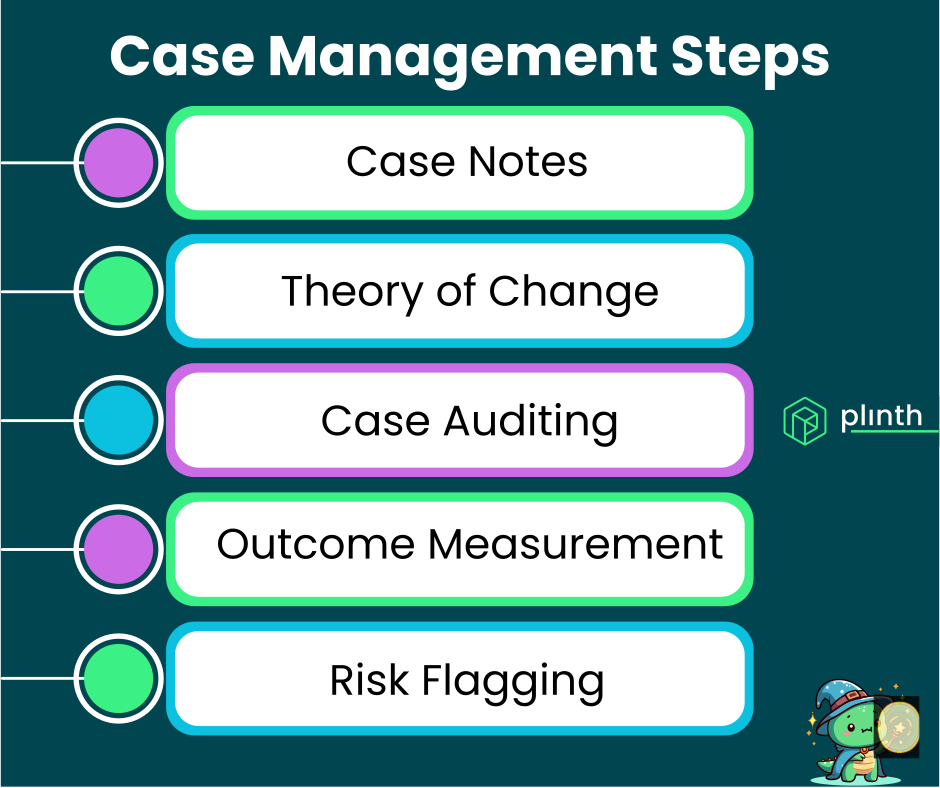
Artificial intelligence is transforming how charities and nonprofits work with case data, automatically analysing notes, generating summaries, and identifying patterns that would take hours to find manually. These capabilities free case workers to focus on direct support rather than paperwork.
What you'll learn: How AI-powered analysis works and the specific capabilities available in modern case management systems.
Practical applications: Real-world uses for AI analysis including supervision, handovers, and identifying at-risk individuals.
Getting started: How to begin using AI analysis features effectively in your organisation.
The Challenge of Case Review
Reviewing case histories is essential but traditionally time-consuming, creating a constant tension between thoroughness and efficiency.
Volume of Information: Active cases accumulate dozens or hundreds of notes over time, making it impractical to read everything before every interaction or meeting.
Supervision Preparation: Case workers preparing for supervision need to summarise their caseload, often spending hours reviewing notes to prepare adequate summaries.
Handover Challenges: When cases transfer between workers, the receiving worker faces a steep learning curve to understand the full history.
Pattern Recognition: Important patterns across a caseload – such as multiple people mentioning similar concerns – are nearly impossible to spot when reviewing cases individually.
These challenges mean important information is often missed, and significant staff time goes into administrative review rather than direct support.
How AI Analysis Works
AI-powered case analysis uses large language models to read, understand, and extract insights from unstructured case notes.
Natural Language Processing: AI systems can understand case notes written in natural language, including abbreviations, informal language, and domain-specific terminology common in charity contexts.
Pattern Recognition: By analysing text at scale, AI can identify recurring themes, track changes over time, and flag potential concerns across many notes.
Summarisation: AI can distil long case histories into concise summaries that capture key information without requiring human review of every note.
Interactive Analysis: Advanced systems allow users to ask questions about cases in natural language and receive relevant answers based on the documented history.
Modern AI capabilities transform case notes from passive records into active sources of insight.
Plinth's AI Case Features
Plinth offers several AI-powered features that transform how organisations work with case data.
Case Conversation Analysis
Ask questions about a case's history and receive AI-generated answers based on all recorded notes.
Natural Questions: Ask questions in plain English like "What housing issues has this person faced?" or "Has there been any mention of mental health concerns?" and receive relevant responses.
Structured Analysis: The AI automatically identifies and extracts key themes including referrals made, problems presented, support given, changes observed, and risk factors.
Follow-Up Questions: After the initial analysis, you can ask follow-up questions to explore specific aspects in more detail.
Comprehensive Context: The AI considers all notes within the case's date range, ensuring nothing relevant is overlooked.
Conversation analysis turns hours of reading into a few seconds of AI processing, while still allowing deep exploration when needed.
Risk Factor Identification
AI analysis specifically looks for indicators of potential risk across multiple domains.
Mental Health Indicators: Language patterns that may suggest mental health concerns, including references to mood, anxiety, or crisis situations.
Safeguarding Concerns: References to abuse, neglect, exploitation, or other safeguarding issues that may require attention.
Housing Instability: Mentions of housing problems, eviction risk, homelessness, or accommodation issues.
Relationship Difficulties: References to family conflict, domestic issues, isolation, or relationship breakdown.
Health Issues: Physical health problems, hospital admissions, or medical concerns mentioned in notes.
Automated risk identification helps ensure important concerns aren't missed, particularly when reviewing unfamiliar cases.
Weekly Summary Generation
Generate concise summaries of recent case activity across your entire caseload.
Automatic Summarisation: With a single click, generate 2-3 sentence summaries of each case's recent activity, capturing key developments.
Bulk Generation: Create summaries for all active cases at once, dramatically reducing time needed to prepare for supervision or team meetings.
Concern-Based Ordering: Summaries are presented sorted by concern level, ensuring high-priority cases are reviewed first.
Fresh Perspective: AI-generated summaries often highlight information that might not stand out when reading notes sequentially but is significant in aggregate.
Weekly summaries transform supervision from a scramble to prepare into a focused discussion of what matters.
Practical Applications
AI analysis capabilities support numerous practical use cases in day-to-day case management.
Supervision and Case Review
AI tools make supervision meetings more efficient and effective.
Preparation: Generate summaries of your caseload before supervision rather than spending hours reviewing notes and writing your own summaries.
Consistency: AI summaries ensure consistent depth of review across all cases, not just the ones that happen to be top of mind.
Focus on Discussion: With preparation time reduced, supervision can focus on discussing complex situations and developing support strategies.
Documentation: AI summaries can be saved as supervision records, providing documentation of regular case review.
Supervision becomes a strategic discussion rather than an administrative catch-up.
Case Handovers
When cases transfer between workers, AI analysis smooths the transition.
Quick Orientation: New case workers can use conversation analysis to quickly understand a case's history without reading every note.
Key Information: AI summaries highlight the most important information, ensuring critical context isn't missed during handover.
Question Answering: If the new case worker has specific questions about the history, they can ask the AI rather than searching through notes.
Reduced Dependency: Handovers are less dependent on the outgoing case worker's availability and memory.
Better handovers mean better continuity of support for the individuals you serve.
Identifying Patterns Across Cases
AI can help identify patterns that span multiple cases or the entire caseload.
Common Issues: Spotting when multiple people are experiencing similar challenges – such as a local housing provider causing problems – that might not be obvious when viewing cases individually.
Service Gaps: Identifying recurring needs that your organisation isn't currently meeting well.
Outcome Patterns: Understanding what approaches tend to work well for different types of situations.
Early Warning: Recognising when certain issues are becoming more prevalent across your caseload.
Pattern recognition transforms case management from individual support to organisational learning.
Urgent Situation Response
When someone presents in crisis, AI analysis helps staff respond with full context.
Quick History: Immediately understand someone's background when they arrive unexpectedly, without having time to read through their file.
Previous Crises: See if similar situations have occurred before and what approaches worked or didn't work.
Support Network: Quickly identify who else is involved in supporting this person and who might need to be contacted.
Risk Context: Understand existing risk factors that may be relevant to the current situation.
Faster access to context means better crisis response.
Getting Started with AI Analysis
Implementing AI analysis effectively requires some preparation and thoughtful rollout.
Prerequisites
Ensure the foundations are in place before relying on AI analysis.
Consistent Documentation: AI analysis is only as good as the notes it has to work with – establish clear expectations for note quality and completeness.
Historical Data: AI analysis works better with more data – if you're just starting case management, the AI will become more useful as notes accumulate.
Staff Buy-In: Help staff understand that AI is a tool to support their work, not replace their judgment.
Appropriate Use: Establish guidelines for when AI analysis is appropriate and when direct note review remains necessary.
AI analysis amplifies good case management practices; it cannot compensate for poor documentation.
Introducing to Your Team
Roll out AI features thoughtfully to ensure effective adoption.
Demonstrate Value: Show staff specific examples of how AI analysis saves time and improves understanding.
Start with Summaries: Weekly summary generation is often the easiest entry point – it's clearly time-saving and non-threatening.
Encourage Exploration: Let staff experiment with conversation analysis on their own cases to understand its capabilities.
Discuss Limitations: Be clear about what AI can and cannot do – it's a tool for synthesis, not a replacement for professional judgment.
Thoughtful introduction leads to meaningful adoption rather than skeptical resistance.
Best Practices
Maximise the value of AI analysis through appropriate use.
Verify Critical Information: When AI surfaces something significant, verify it in the original notes before taking action.
Combine with Judgment: Use AI analysis as input to your thinking, not as the final answer – your professional expertise remains essential.
Note Quality: Encourage detailed, clear notes knowing they'll be analysed – this benefits both AI analysis and traditional review.
Regular Use: Build AI summary review into regular routines rather than only using it occasionally.
Consistent, thoughtful use yields the greatest benefits.
Ethical Considerations
Using AI for case analysis raises important ethical questions that organisations should address.
Data Privacy
AI analysis processes sensitive personal information that must be protected.
Data Handling: Understand how your case management provider handles data used for AI analysis – Plinth does not use your data to train AI models.
Access Controls: Ensure AI analysis features are only available to staff with appropriate access to the underlying case information.
Transparency: Consider whether to inform individuals that AI tools may be used to analyse their case records.
Privacy protections for AI analysis should match or exceed those for traditional case review.
Human Oversight
AI should support rather than replace human judgment in case management.
Professional Responsibility: Case workers remain responsible for the quality of support provided – AI provides input, not decisions.
Verification: Important information surfaced by AI should be verified in source notes before being acted upon.
Limitations: Recognise that AI can miss context, misunderstand terminology, or surface information without appropriate nuance.
Oversight Structures: Maintain supervision and management oversight of case decisions regardless of AI involvement.
Human-in-the-loop approaches ensure AI supports rather than supplants professional practice.
Bias and Fairness
AI systems may inadvertently introduce or amplify biases.
Language Assumptions: AI trained on majority language patterns may misunderstand or misinterpret notes written by non-native speakers or using specific community terminology.
Risk Flagging: Automated risk identification may over-flag certain populations if not carefully calibrated.
Consistent Application: Ensure AI tools are applied consistently across your caseload, not selectively.
Regular Review: Periodically review whether AI analysis is providing equitable value across different case types and populations.
Awareness of potential biases enables more thoughtful and equitable use of AI tools.
Frequently Asked Questions
Can AI replace case workers?
No. AI in case management is designed to augment human work, not replace the professional relationships and judgment that are central to effective support.
Administrative Support: AI excels at tasks like summarisation and pattern recognition that are time-consuming but don't require human relationship.
Professional Judgment: Decisions about what support to provide, how to respond to disclosures, and how to build trust require human expertise.
Relationship: The supportive relationship between case worker and individual cannot be replicated by AI.
AI handles paperwork so humans can focus on people.
Is AI analysis accurate?
AI analysis is generally accurate for summarisation and pattern identification, but should be verified for critical decisions.
Summarisation: AI is good at condensing information and identifying key themes, though may occasionally miss nuance.
Risk Identification: AI can flag potential concerns but may produce false positives or miss subtle indicators.
Interpretation: Complex situations may require human interpretation to understand context that AI cannot access.
Treat AI analysis as a knowledgeable colleague's perspective – useful input that you verify and consider alongside your own judgment.
How do we ensure confidentiality?
Work with your software provider to understand data handling and implement appropriate controls.
Provider Practices: Understand how your case management provider processes data for AI analysis and what protections are in place.
Access Controls: Ensure only authorised staff can use AI analysis features.
Output Handling: Treat AI-generated summaries and analysis with the same confidentiality as source case notes.
AI analysis should operate within your existing confidentiality framework, not outside it.
Recommended Next Pages
The Complete Guide to Case Management – Comprehensive coverage of case management principles and features.
Case Management Software for Charities – Evaluating software options for your organisation.
Case Management Best Practices for Nonprofits – Expert recommendations for effective case management.
Understanding Case Concern Levels and Risk Assessment – Using concern levels to prioritise your caseload.
Last updated: July 2026
For more information about AI-powered case analysis, contact our team or schedule a demo.