Case Management and Safeguarding: What Your System Needs to Do
How your case management system should support safeguarding practice in charities and local authority teams. What to look for, what to avoid, and how to build a safeguarding-ready recording culture.
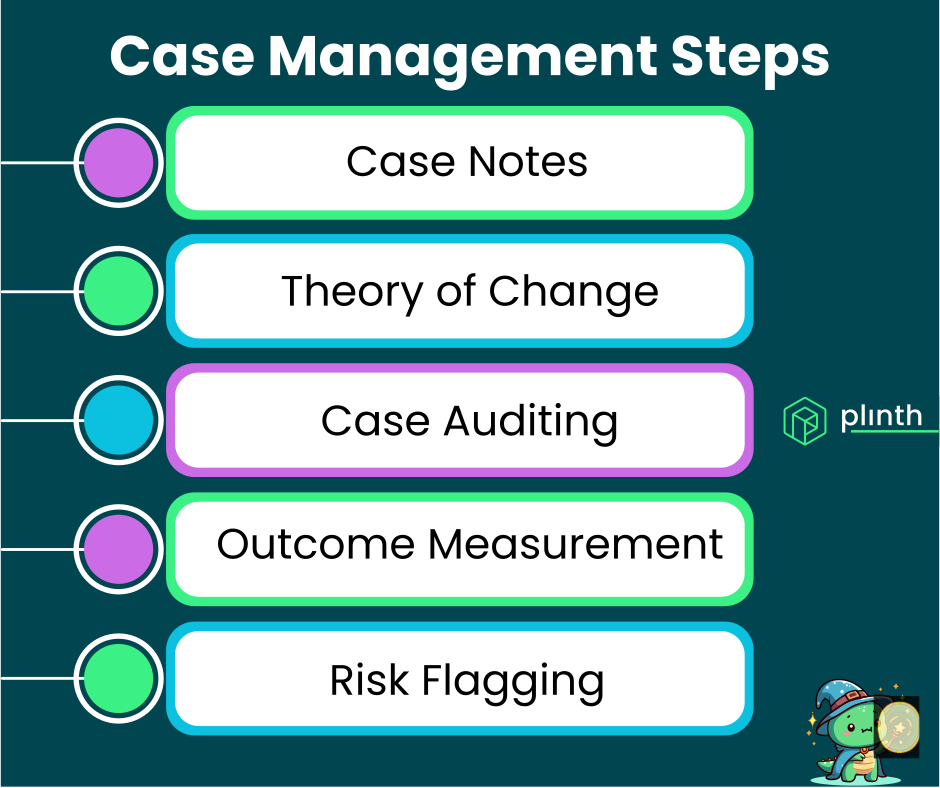
Safeguarding is not a separate activity from case management. It is the lens through which all case management practice should be viewed. The case management system your organisation uses either supports good safeguarding practice or creates barriers to it — and in the most serious cases, those barriers have consequences that cannot be undone.
This guide is not about safeguarding policy or procedure. It is specifically about what your case management system needs to do to support safeguarding in practice.
What you'll learn: The specific technical and practice requirements that make a case management system suitable for safeguarding-conscious organisations, and the common gaps that create risk.
The baseline: Every charity and nonprofit working with vulnerable adults, children, or families needs to be able to demonstrate, under scrutiny, that they maintained appropriate records, identified risks appropriately, and acted on concerns in a timely way. Your case management system is the primary evidence base for that demonstration.
Why Case Records Matter for Safeguarding
When a safeguarding concern occurs — or when a serious incident review is conducted — case records are the primary source of evidence about what was known, when it was known, and what action was taken.
The Questions That Will Be Asked: Did the organisation know about the risk? Were warning signs recorded? Were they acted on? Was the case appropriately escalated? Were decisions documented with reasoning? Were appropriate referrals made?
The Cost of Poor Records: If the answers to these questions cannot be found in case records, the organisation is unable to demonstrate compliance with its safeguarding duty — regardless of what actually happened in practice. The undocumented action is the indefensible action.
Positive Evidence: Good records do not just protect the organisation when things go wrong. They demonstrate consistently good practice to Ofsted, CQC, Local Authority Designated Officers (LADOs), and other scrutiny bodies.
Recording is safeguarding. A system that makes recording easy, consistent, and complete is a system that supports safeguarding.
What a Safeguarding-Ready Case Management System Requires
Complete and Auditable Case Records
Chronological Timeline: Every interaction with a service user should be recorded in a complete, chronological timeline. No gaps, no lost notes, no undated entries.
Timestamped Records: Records should be timestamped at the point of creation, not backdated. A note recorded at 4pm on Tuesday is evidence; a note claimed to have been written at 4pm on Tuesday but created three days later is not.
Immutable Records: Once a note is submitted, it should not be silently editable. Corrections should be made through addenda, not by overwriting the original.
Author Attribution: Every record should clearly identify who created it. In a safeguarding review, knowing which worker made a note and when is often critical.
Plinth's interaction tracking meets all of these requirements — every note is timestamped, attributed, and cannot be silently amended.
Access Controls and Confidentiality
Role-Based Permissions: Not all staff should have access to all case records. Access should be determined by role and justified by need.
Private Notes: Some case information is particularly sensitive — disclosures relating to domestic abuse, sexual violence, or information from third parties who may be at risk. The ability to mark notes as private, accessible only to named individuals, is an important safeguarding tool.
Manager Override: Supervisors and managers need appropriate access to cases for oversight purposes, including cases not directly assigned to them.
Audit Trail of Access: Knowing who accessed a record and when can be important in safeguarding reviews. This requires a system that logs access, not just changes.
Concern Level and Escalation Visibility
Clear Risk Flags: The concern level system — Low, Medium, High — provides visible, team-wide indication of current risk. In a safeguarding context, High concern should trigger defined response protocols.
Escalation History: When a concern level changes — particularly when it is escalated to High — the record should show who made the change, when, and ideally why.
Supervisor Visibility: Managers need to be able to see the concern level distribution across their team's caseload, ensuring that high-concern cases are receiving appropriate oversight.
Concern level visibility is the mechanism by which individual worker assessments become team-wide safeguarding awareness.
Documentation of Safeguarding Decisions
Record the Reasoning, Not Just the Decision: When a worker decides not to escalate a concern, or decides to make a referral to children's or adult safeguarding services, that decision and its reasoning should be documented.
Record What Was Said: Notes of conversations where safeguarding concerns are raised — with the service user, with supervisors, with statutory services — should be recorded as soon as possible and in detail.
Record Referrals and Outcomes: If a referral is made to statutory services, record what was referred, when, to whom, and what the response was. This is often the most scrutinised part of a case record.
Record Multi-Agency Discussions: Case conferences, multi-agency risk assessment conferences (MARACs), and other formal multi-agency processes should be documented comprehensively.
Supporting Flagging and Escalation in Practice
The best safeguarding is proactive — identifying risk before a disclosure or incident. Your case management system should support this.
AI Analysis for Risk Signals: Plinth's AI analysis reviews case notes for language patterns associated with safeguarding risk — mentions of domestic difficulties, mental health deterioration, housing instability, and other risk factors. It brings these to the attention of workers and managers who might not have noticed them in a busy week.
Inactivity Flags: A high-concern case that has not had contact for several weeks is a safeguarding risk. A system that surfaces this proactively is a safeguarding asset.
Supervision Integration: AI-generated summaries sorted by concern level make safeguarding review a core part of every supervision session, not an afterthought.
Common Safeguarding Gaps in Case Management Practice
Understanding where things go wrong helps organisations close the gaps before they matter.
The "Unwritten Note" Problem
Workers often intend to write a note but don't get to it for days — by which time the detail has faded and the urgency has passed. Safeguarding disclosures or significant concerns that are not recorded promptly are a serious risk.
The Solution: A clear organisational expectation that notes are recorded on the day of the contact, combined with a system that makes mobile recording fast and easy.
The Handover Gap
When a worker goes on leave, changes role, or leaves the organisation, the incoming worker does not have the accumulated contextual knowledge that the previous worker held.
The Solution: Comprehensive case records that give a new worker an accurate picture of the case history, combined with AI summary tools that can generate a rapid briefing on any case.
Dispersed Information
Information about a service user's safeguarding situation may exist in emails, text messages, informal conversations, and paper notes — none of which are in the case management system.
The Solution: A strong organisational norm that all information relevant to a case is recorded in the case management system, even if it came through an informal channel. "If it's not in Plinth, it didn't happen" is a useful cultural principle.
Under-Escalation
Workers sometimes identify concerns but do not escalate them because they are uncertain whether the concern is serious enough, they fear being wrong, or the escalation process feels burdensome.
The Solution: Low-barrier consultation processes, a team culture that treats escalation as good practice rather than failure, and a system that makes it easy to flag a case as medium or high concern.
Safeguarding and Data Protection
Safeguarding records contain some of the most sensitive personal data an organisation holds. Getting the balance right between safeguarding and data protection requires careful thought.
Data Minimisation: Record what is relevant to the safeguarding concern, not everything you know about the person. Data protection law requires minimisation.
Retention: Safeguarding records have specific retention requirements under sector guidance. Your case management system should support appropriate retention and deletion policies.
Access to Records: Individuals have the right to request access to their case records under UK GDPR. However, there are exemptions where disclosure could harm the individual or others. Legal advice should be sought in complex cases.
See Case Management, GDPR, and Data Protection for comprehensive guidance on data protection in case management.
Frequently Asked Questions
Does Plinth meet safeguarding requirements?
Plinth is designed to support safeguarding-conscious practice through comprehensive audit trails, access controls, concern level systems, and AI-powered risk identification. However, safeguarding practice is the responsibility of the organisation — the system supports good practice but does not substitute for it.
How do we handle safeguarding records that need to be kept separately?
Some organisations maintain separate safeguarding files for the most sensitive cases. Plinth's private note function allows sensitive records to be restricted to named individuals while remaining within the overall case management system.
What should we do if we receive a safeguarding disclosure during a recorded session?
If a disclosure is made during a session, record it in detail as soon as the session ends — including what was said, by whom, in what context, and what your response was. Do not wait until the end of the day.
How long should safeguarding records be kept?
This varies by organisation type and the nature of the records. Sector guidance from the NSPCC and the Child Protection in Sport Unit (CPSU) recommends that child protection records are kept until the child reaches at least 25 (seven years after school leaving age), with many organisations retaining safeguarding records for considerably longer — best practice is often cited as 50 years or more, because disclosures of historic abuse frequently come decades after the events. Adult safeguarding retention periods depend on the regulatory context (for example, CQC-regulated services follow their own guidance). NCVO advises only keeping records for as long as is necessary, so every organisation should set a written retention schedule and seek specific guidance for its setting.
Recommended Next Pages
Information Sharing in Safeguarding – Detailed guidance on information sharing agreements, lawful bases, and the seven golden rules for UK charities.
Spotting Risks Before They Happen – How to identify deteriorating cases before they reach crisis or safeguarding threshold.
Understanding Case Concern Levels and Risk Assessment – How to use concern levels to maintain safeguarding awareness.
How to Track Case Interactions and Notes – Best practices for recording that supports safeguarding.
Case Management, GDPR, and Data Protection – Data protection requirements for sensitive case records.
The Complete Guide to Case Management – Comprehensive coverage of case management principles and features.
Last updated: February 2026
To learn how Plinth supports safeguarding-ready case management, book a demo or contact our team.