Case Management for Housing Support Services
How housing support charities, housing associations, and local authority housing teams can use case management software to track support journeys, identify risk, and evidence outcomes for tenants and rough sleepers.
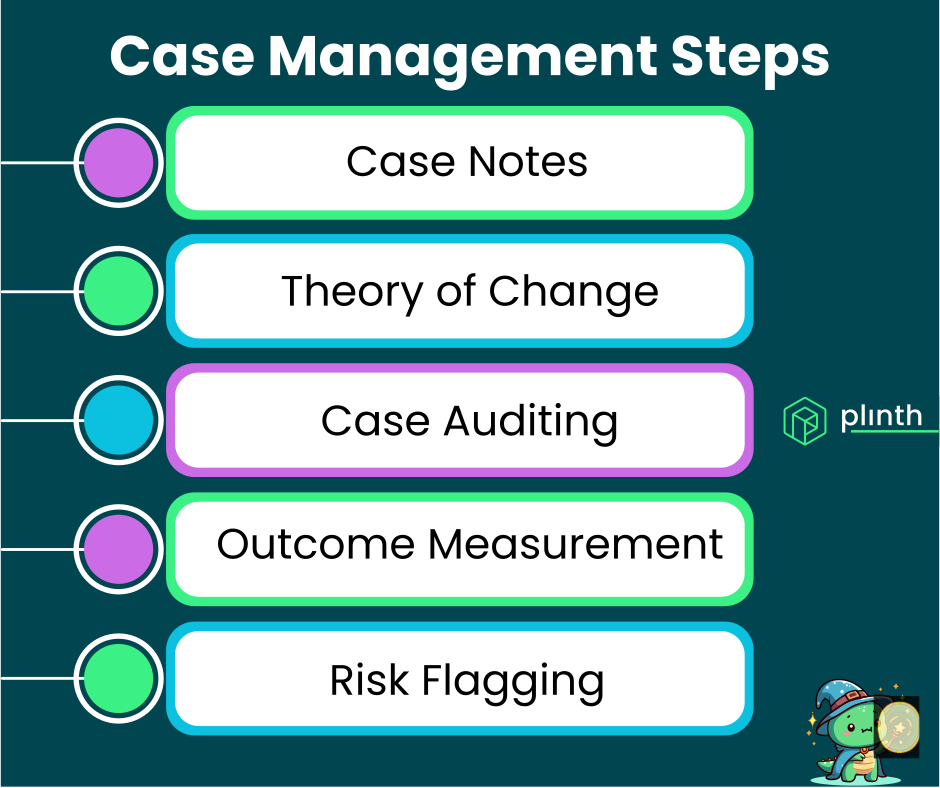
Housing support work is among the most complex and consequential case management in the voluntary and public sector. The stakes are high: housing instability is a risk factor for deteriorating mental health, family breakdown, domestic abuse, substance use, and contact with the criminal justice system. Getting the case management right — recording well, reviewing regularly, spotting risk early, and coordinating with partners — is directly linked to whether people end up housed or not.
What you'll learn: The specific case management needs of housing support services, how to structure workflows and recording for different housing pathways, and how purpose-built case management tools support better outcomes for people experiencing housing difficulty.
Who this is for: Case managers, support workers, service managers, and digital leads in housing charities, homelessness services, supported housing providers, tenancy sustainment teams, and local authority housing support services.
Plinth in housing: Plinth is used by housing support teams and early intervention services working with people at risk of homelessness, including services working alongside local authority housing departments in London.
The Case Management Challenges Specific to Housing Support
Housing support work has a number of features that create specific demands on case management systems.
Multiple, Overlapping Pathways
People accessing housing support are rarely on a single, linear journey. A single individual may be:
- Working through a temporary accommodation pathway
- In a rough sleeper outreach caseload
- On a waiting list for supported housing
- Receiving tenancy sustainment support
- Engaged with a floating support service
Each of these may be delivered by different teams, with different recording requirements, different outcome frameworks, and different responsible organisations. Good case management needs to reflect this complexity without requiring parallel records in multiple systems.
Pathway Visibility: Plinth's workflow builder allows housing teams to configure distinct pathways for different service offers — rough sleeper outreach, move-on support, tenancy sustainment, and so on — each with their own stage-based progression and colour coding for easy visual identification.
High Complexity and Co-Occurring Needs
People experiencing housing instability frequently have co-occurring needs — mental health difficulties, substance use, domestic abuse, debt, and sometimes involvement with the criminal justice system. Housing is often both a symptom of these difficulties and a factor that makes them harder to address.
Rich Recording: Housing support case records need to be able to capture complex, multi-dimensional situations in depth. Brief, tick-box recording is insufficient for the levels of complexity involved.
Multi-Agency Coordination: Housing support workers routinely work alongside mental health teams, substance use services, domestic abuse services, and social care. Recording multi-agency involvement clearly is essential — see Multi-Agency Case Management.
Safeguarding Intersections: Housing instability significantly increases safeguarding risk. Housing support case management must support rigorous safeguarding recording and escalation. See Case Management and Safeguarding.
Fast-Moving Situations
Housing situations can change rapidly. A person who was in stable temporary accommodation on Monday may be on the street by Thursday. A rough sleeper who was engaged may disengage suddenly and become very hard to reach.
Real-Time Updates: Housing support case records need to be updated in real time, from the field, not retrospectively from a desk. Mobile recording capability is not optional — it is essential.
Concern Level Responsiveness: The concern level system needs to be actively managed in housing contexts, where escalation from low to high concern can happen in days rather than weeks.
Inactivity as a Risk Signal: A rough sleeper or someone in unstable accommodation who goes quiet is not necessarily stable — they may have lost a phone, moved location, or be in crisis. Cases that go quiet need active review, not passive assumption of stability.
Prevention vs. Crisis Response
Housing support operates across a spectrum from early prevention (supporting tenants at risk of losing their home) to crisis response (supporting people with no home at all). The case management needs are different at each point.
Prevention Focus: Early intervention and prevention teams working with tenants at risk need light-touch, high-volume case management that supports brief, frequent contacts and tracks small changes in trajectory.
Crisis Response: Rough sleeper outreach and emergency accommodation support involves more intensive, higher-risk case management with greater safeguarding demands and more complex multi-agency coordination.
A good case management system should flex to serve both ends of this spectrum.
Structuring Housing Support Workflows in Plinth
Plinth's workflow configuration allows housing teams to design pathways that reflect their actual service delivery model.
Example Pathways for Housing Services
Rough Sleeper Outreach Pathway:
- Initial contact and engagement
- Needs assessment
- Immediate crisis support
- Pathway planning (temporary accommodation, treatment, family reconnection)
- Move-on support
- Settled accommodation and closure
Tenancy Sustainment Pathway:
- Referral and risk assessment
- Support planning
- Active tenancy support (typically 3–12 months)
- Step-down support
- Independent living and closure
Homelessness Prevention Pathway:
- Referral (often from housing department)
- Crisis assessment
- Debt and benefits support
- Housing options advice
- Mediation and dispute resolution (where applicable)
- Stabilisation and closure
Each pathway can be configured in Plinth with its own colour coding, stages, and associated recording templates.
Housing-Specific Concern Level Criteria
In housing contexts, concern level criteria need to reflect the specific risk factors relevant to housing instability.
High Concern (Red):
- Active eviction proceedings
- Rough sleeping or immediate homelessness
- Domestic abuse situation with housing implications
- Mental health crisis with housing consequences
- Safeguarding concern
Medium Concern (Amber):
- Rent arrears accumulating
- Tenancy at risk
- Engagement dropping
- Co-occurring needs destabilising
- Recent period of rough sleeping with current accommodation
Low Concern (Green):
- Stable accommodation, situation improving
- Engaged with support, progressing
- Monitoring for sustainability
Clear, housing-specific concern level criteria support consistent assessment across the team and reliable data for service-level reporting.
Risk Detection in Housing Support Cases
Housing support workers need to catch deteriorating situations early. Plinth's AI analysis tools are particularly well-suited to this.
The Warning Signs in Housing Cases
Financial Signals: Mentions of inability to pay rent, accumulating debt, benefit problems, or sanctions are significant early warning indicators in tenancy sustainment cases.
Mental Health Changes: Changes in presentation, withdrawal, mentions of not coping, or explicit disclosure of mental health difficulties are risk factors for housing instability.
Disengagement Patterns: Missed appointments, phones not answered, and reduced contact frequency are classic early warning signs in rough sleeper and high-support caseloads.
Third-Party Concerns: Concerns raised by neighbours, landlords, or other services about a service user's wellbeing or behaviour may reach the case worker before the service user discloses directly.
Plinth's AI analysis reviews case notes for language patterns associated with these risk signals — surfacing them for review at the case and caseload level.
The Static Case Problem
In housing support, a case that appears unchanged can actually be deteriorating.
Regular Contact Schedules: For high-concern cases, agree and record a contact schedule — and review cases where that schedule is not being met.
Inactivity Review: Any housing case that has not been updated for more than two weeks should be reviewed, regardless of concern level. In housing contexts, inactivity is often a warning sign.
Re-engagement Protocols: Define what happens when contact is lost — how many attempts are made, through what channels, and at what point the case is escalated or closed.
Evidencing Impact in Housing Support
Housing funders and local authority commissioners require clear evidence that services are achieving outcomes.
Core Housing Outcome Metrics
Housing Status at Exit: What proportion of cases closed with the service user in stable housing? Breaking this down by pathway type (rough sleeper, tenancy sustainment, prevention) provides nuance.
Tenancy Sustain Rate: For tenancy sustainment services, what proportion of at-risk tenancies were sustained for a defined period (typically 12 months)?
Reduced Evictions: For prevention services, what proportion of cases that entered with eviction risk successfully avoided eviction?
Reduced Rough Sleeping: For rough sleeper services, what proportion moved into stable accommodation within a defined period?
Repeat Presentations: Are people returning to crisis services? A low re-presentation rate is evidence of sustained change.
Plinth's reporting tools make it straightforward to produce these metrics from case data without manual compilation.
Qualitative Evidence
Housing stories are among the most compelling in the charity sector. Anonymous case studies of people who moved from rough sleeping to stable housing, or who kept their tenancy after facing eviction, bring funders' impact reports to life.
Plinth's AI case analysis can help generate case study narratives from case records efficiently, with appropriate anonymisation.
Working with Local Authority Housing Services
Many housing support services operate in close partnership with local authority housing departments, homelessness services, and allocations teams.
Plinth Alongside Statutory Systems: Plinth is not a replacement for local authority housing management systems. It works alongside them, providing the case management infrastructure for the voluntary sector or specialist team's support work.
Recording Multi-Agency Activity: All contacts with housing departments, allocations teams, and statutory homelessness services should be recorded in Plinth's case timeline — including referrals made, responses received, and decisions affecting the case.
Evidence for Statutory Processes: Well-maintained Plinth case records provide powerful evidence when advocating for a service user in statutory processes — presenting panels, allocation decisions, and homelessness assessments.
For local authority teams using Plinth directly, see Why Plinth Works for Local Authority Teams.
Frequently Asked Questions
Can Plinth be used for rough sleeper outreach work?
Yes — Plinth's mobile-responsive interface and cloud-based access make it well suited for outreach work. Workers can record contacts in the field from a phone or tablet, without needing to return to an office.
GPS and Location: While Plinth does not automatically record location data, workers can note location information in contact records where relevant.
How do we handle cases involving people without a fixed address?
Plinth's individual records do not require a fixed address. Cases can be created and managed for people whose housing situation is in flux — including those with no fixed abode.
Address Updates: Housing address can be updated as a person's situation changes, maintaining an accurate current record.
What outcome frameworks are relevant for housing support?
Common frameworks and reference points used in housing support include:
- MHCLG's Rough Sleeping Data Framework and Local Outcomes Framework
- Rough Sleeping Initiative evaluation indicators
- The Outcomes Star — particularly the Home Star (which replaced the Homelessness Star in 2022), developed by Triangle Consulting Social Enterprise
- Local authority commissioning frameworks (which vary by borough)
Plinth's flexible recording structure can accommodate any of these frameworks within case notes and structured fields.
Recommended Next Pages
Spotting Risks Before They Happen – Early warning indicators specific to housing instability and how to surface them.
Multi-Agency Case Management – Coordinating housing support across local authorities, health services, and voluntary organisations.
Case Management and Safeguarding – Safeguarding practice in high-risk housing contexts.
Measuring Outcomes in Case Management – How to evidence housing outcomes for funders and commissioners.
Why Plinth Works for Local Authority Teams – How Plinth supports local authority housing and prevention services.
The Complete Guide to Case Management – Comprehensive coverage of case management principles and features.
Last updated: February 2026
To learn how Plinth supports housing support teams, book a demo or contact our team.