Why Plinth Works for Local Authority Teams
How Plinth supports local authority prevention, early intervention, and community support teams. Real-world experience working with Camden, Newham, Kensington and Chelsea, and how to run a successful pilot.
On this page6
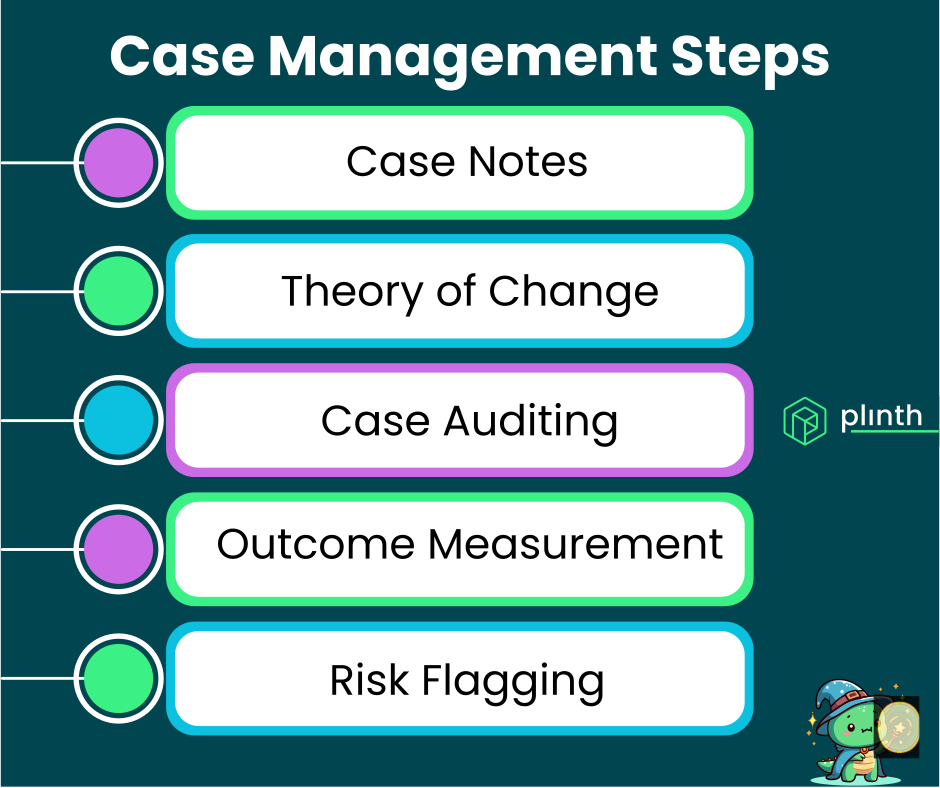
Local authority prevention and early intervention teams occupy a uniquely complex position. They work at the interface of statutory services and the voluntary sector, often under pressure to demonstrate impact with limited budgets, using tools that were built for either large statutory systems or small community organisations — neither of which quite fits.
Plinth was not designed for this space by accident. It grew out of direct work with local authority teams and their voluntary sector delivery partners across London — understanding what works in practice, what creates friction, and what genuinely helps frontline workers do their jobs better.
What you'll learn: Why Plinth is a strong fit for local authority prevention and early intervention teams, what that looks like in practice, and how to run a successful pilot with a small team.
Real-world context: Plinth has been used by and alongside teams in Camden, the London Borough of Newham, and the Royal Borough of Kensington and Chelsea. The lessons from that experience shape everything we build.
The Gap That Plinth Fills
Most local authority teams face the same technology challenge: the statutory social care platforms are too expensive and too complex for prevention work, while the generic CRM tools require too much configuration and lack the sector-specific features prevention teams need.
What statutory platforms do poorly for prevention:
- They impose the language and process of statutory social care on teams doing lighter-touch work
- They are expensive, slow to implement, and require significant IT resource to configure and maintain
- Frontline workers find them time-consuming and bureaucratic
What generic CRMs do poorly:
- They require extensive configuration to behave like case management software
- They lack concern level systems, workflow management, and outcome tracking built for support services
- They feel like sales tools — because they are
What Plinth provides:
- Purpose-built case management designed for prevention and community support work
- Fast implementation (teams are operational within days, not months)
- Affordable, transparent pricing that fits voluntary sector and council prevention budgets
- AI-powered tools that help workers and managers see patterns and manage risk
Plinth fills the gap between statutory platforms that are too heavy and generic tools that are too light.
Working with London Borough Councils
Plinth's work with London borough partners has shaped our understanding of what local authority prevention teams actually need from case management software.
Camden
Work with teams in Camden has highlighted the importance of flexibility in workflow design. Prevention services in Camden span a wide range of delivery models — from structured family support programmes to community-based drop-in support — and a one-size-fits-all approach to case management does not work.
What We Learned: Teams need to be able to create distinct pathways for different service offers without requiring IT support for each change. Plinth's self-service workflow builder was developed in response to exactly this need.
What It Changed: Workers spend less time navigating a system that doesn't fit their practice and more time recording useful information. Managers get clearer caseload oversight because the system reflects the actual shape of the work.
London Borough of Newham
Newham's prevention and community support landscape involves a complex mix of council-run services, commissioned voluntary sector partners, and community organisations working under different governance arrangements.
What We Learned: Teams that are part of a local authority ecosystem but not directly part of statutory social care need a system that is credible to council commissioners without being the same as the statutory social care platform. They need to be able to share data and evidence with commissioners in formats that commissioners trust.
What It Changed: Plinth's reporting features — including outcome tracking and caseload reporting — are directly usable for contract monitoring and grant reporting, reducing the administrative burden of evidencing impact to the council.
Royal Borough of Kensington and Chelsea
Work in Kensington and Chelsea has involved early intervention and prevention services working with some of the most complex and diverse communities in London, including families who have experienced significant trauma and systemic disadvantage.
What We Learned: In communities with high levels of complexity and need, the quality of case recording matters enormously. Workers need tools that support rich, reflective documentation — not just tick-box forms. They also need AI tools that can help them synthesise complex case histories quickly.
What It Changed: Plinth's AI case analysis has been particularly valued in this context — enabling workers and supervisors to review complex histories efficiently and to identify risk signals that might be buried in extensive case notes.
What Local Authority Teams Get From Plinth
Lightweight Enough for Prevention, Robust Enough for Accountability
Local authority commissioners and contract managers need to know that the systems their partners use are secure, compliant, and capable of producing reliable data. Plinth meets these requirements without imposing the overhead of a statutory platform.
UK GDPR Compliant: All data is stored securely in the UK, with role-based access controls, complete audit trails, and privacy-by-design principles throughout.
Reliable Reporting: Standard reports cover the metrics commissioners most commonly require — cases opened and closed, outcomes achieved, concern levels, and worker activity.
No IT Department Required: Plinth can be set up and configured by service managers without specialist IT support, reducing the barriers to adoption for small and medium teams.
Designed for the Prevention Worker's Day
Prevention workers have different rhythms to statutory social care workers. They might do drop-in sessions, community outreach, home visits, and phone contacts all in a single day — each of which needs to be recorded quickly and accurately.
Mobile Recording: Plinth works on any device with a browser. Workers record contacts on their phone or tablet immediately after a session, while the details are fresh.
Fast Entry: A brief contact note can be added in under a minute. Longer, more detailed notes are equally easy to write. The system does not impose a template that is irrelevant to the type of contact.
Case Overview at a Glance: Workers and managers can see the full picture of a case — current concern level, recent contacts, workflow stage, assigned worker — without navigating through multiple screens.
AI That Supports Prevention Practice
Plinth's AI tools are particularly valuable in the prevention context, where cases often have long, complex histories and where risk is not always visible in any single interaction.
Case Summaries for Supervision: Before a supervision session, a manager can generate a one-paragraph summary of each worker's cases — enabling focused discussion of the cases that need attention without spending the whole session recapping history.
Risk Pattern Analysis: The AI analyses case notes for language patterns associated with deteriorating situations — housing instability, mental health changes, relationship difficulties — and surfaces these for review.
Handover Support: When a case is transferred to a new worker, the AI summary gives them an immediate grounding in the case history without needing to read every note.
In prevention work, catching a deteriorating situation six weeks earlier can prevent a statutory escalation. AI tools that surface risk signals earlier are not a luxury — they are a core practice tool.
How to Run a Successful Pilot
For local authority teams evaluating Plinth, a structured pilot is the right way to build confidence before committing to full rollout.
What a Good Pilot Looks Like
Scale: A pilot typically involves 3–8 workers over a period of 3–6 months. Large enough to generate meaningful data, small enough to learn and adjust without organisation-wide disruption.
Scope: The pilot should cover the core use cases your team most needs to evaluate: recording contacts, managing caseloads, supervision support, and reporting. Start with these before exploring more advanced features.
Clear Evaluation Criteria: Agree in advance what success looks like. Possible criteria include:
- Worker satisfaction with recording ease
- Quality and completeness of case records
- Time saved in supervision preparation
- Ease of producing reporting data
- Manager confidence in caseload visibility
Setting Up the Pilot
Configure Workflows First: Before workers start recording, spend time configuring the pathways and workflows to reflect your actual services. Workers who start with a well-configured system have a much better experience than those who start with a blank canvas.
Appoint a Champion: Identify one worker or manager who will be the internal champion for the pilot — someone who is enthusiastic about the platform and willing to help colleagues when they have questions.
Plinth Onboarding Support: Our team works directly with organisations during the pilot phase to ensure the system is set up well and to answer questions as they arise. You are not doing this alone.
Evaluating the Pilot
At the end of the pilot period, evaluate against your agreed criteria and collect feedback from workers and managers.
Worker Feedback: Was the system easy to use? Did it fit their practice? What would they want to change?
Manager Feedback: Did it give them the visibility they need? Was supervision easier? Were reports useful?
Data Quality: Review the quality of records created during the pilot. Are they complete? Do they contain the information needed for reporting and practice review?
Next Steps: Use pilot learnings to refine the configuration before full rollout, and to make the case to senior management or commissioners for investment in wider adoption.
Common Questions from Local Authority Teams
Do we need council IT approval to use Plinth?
This depends on your organisation's governance arrangements. For voluntary sector organisations working alongside councils, Plinth can typically be adopted without council IT sign-off. For directly employed council staff, you may need to go through a data protection impact assessment and IT security review.
What Plinth Provides: We can provide documentation to support data protection reviews, including information on data residency, security practices, and GDPR compliance. Most organisations find this process straightforward.
Can Plinth share data with statutory social care systems?
Plinth is not designed to directly integrate with statutory social care platforms. However, it supports clear information sharing in practice.
Export Formats: Data can be exported in standard formats for inclusion in multi-agency reviews or information-sharing responses.
Recording Multi-Agency Activity: Workers can record referrals, contacts with statutory services, and outcomes of those referrals within Plinth's case notes, maintaining a clear picture of multi-agency involvement.
What happens to our data if we stop using Plinth?
Your data is always yours. If you decide to move away from Plinth, we provide your data in a portable format so you can migrate to another system or retain records as required.
Data Retention: We help organisations understand their data retention obligations under GDPR and configure appropriate retention settings.
Can voluntary sector partners access cases with council workers?
Plinth supports multi-user access with role-based permissions, allowing different team members to see different levels of information. However, formal data-sharing between council and voluntary sector staff requires an appropriate information-sharing agreement in place.
Practical Arrangements: Many local authority prevention partnerships use Plinth within individual organisations (a commissioned voluntary sector provider, for example) rather than across the whole partnership system.
Recommended Next Pages
Case Management for Early Prevention Teams – How prevention teams use case management to intervene before situations escalate.
Best Case Management Systems for UK Charities – How to evaluate and choose the right system for your organisation.
Spotting Risks Before They Happen – How good systems surface early warning signs in case data.
AI-Powered Case Analysis and Summaries – How artificial intelligence supports supervision and risk management.
The Complete Guide to Case Management – Comprehensive coverage of case management principles and features.
Last updated: August 2026
To talk about how Plinth could work for your local authority or prevention team, book a demo or contact our team.