How to Manage Stakeholder Relationships as a Charity
A practical how-to guide for charities managing relationships with funders, partners, commissioners, trustees, and beneficiaries. Includes tools, frameworks, and common mistakes to avoid.
On this page11
Charities do not operate in isolation. Every nonprofit manages a web of relationships — with funders, partner organisations, commissioners, trustees, regulators, beneficiaries, volunteers, and the wider community. How well you manage these relationships directly affects your ability to deliver your mission, secure funding, and sustain your organisation.
TL;DR: Effective stakeholder management starts with mapping who your stakeholders are and what they need from you. Use a structured approach: categorise stakeholders by influence and interest, assign relationship owners, establish communication rhythms, and invest in tools that make relationship management systematic rather than ad-hoc. For partner organisations specifically, a Partner CRM replaces email and spreadsheets with structured workflows.
What you'll learn: A practical, step-by-step approach to managing stakeholder relationships across every category that matters to your charity.
Who this is for: Charity CEOs, operations managers, partnership coordinators, and anyone responsible for maintaining relationships beyond individual donors.
Why Stakeholder Management Matters for Charities
Charities are relationship-dependent organisations. Unlike businesses that can grow through marketing spend and product improvement alone, charities depend on trust, collaboration, and goodwill from multiple stakeholder groups simultaneously.
Poor stakeholder management has concrete consequences:
- Lost funding. Funders who feel uninformed or undervalued do not renew grants. Poor communication is one of the most commonly cited reasons funders end grant relationships.
- Partnership breakdown. Partner organisations that do not receive timely referral responses or outcome data stop collaborating.
- Regulatory risk. The Charity Commission expects charities to maintain effective governance relationships, including with trustees and auditors.
- Reputational damage. Beneficiaries, communities, and the public hold charities to high relational standards.
Charities with structured approaches to stakeholder management consistently report stronger funder relationships and longer multi-year partnerships than those that handle stakeholder communication ad hoc.
Step 1: Map Your Stakeholders
Before you can manage relationships effectively, you need to know who your stakeholders are. Most charities underestimate the breadth of their stakeholder landscape.
Common Charity Stakeholder Categories
| Category | Examples | What they need from you |
|---|---|---|
| Funders | Trusts, foundations, government, corporate donors | Impact evidence, financial accountability, timely reporting |
| Partner organisations | Other charities, housing associations, health services | Referral responsiveness, shared data, collaboration |
| Commissioners | Local authorities, NHS bodies, government departments | Performance data, outcomes evidence, compliance |
| Trustees and governance | Board members, advisory panels | Strategic updates, risk information, decision-ready papers |
| Beneficiaries | Individuals and communities you serve | Quality services, responsiveness, respect |
| Regulators | Charity Commission, ICO, CQC (if applicable) | Compliance, transparency, timely filings |
| Staff and volunteers | Employees, regular volunteers, pro-bono supporters | Communication, recognition, development |
| Public and media | Local community, journalists, social media audiences | Transparency, impact stories, accessibility |
The Influence-Interest Matrix
Once you have listed your stakeholders, plot them on an influence-interest matrix to prioritise your effort.
High influence, high interest (Manage closely): Funders, commissioners, key partners, trustees. These stakeholders have both the power to affect your organisation and active interest in your work. They require the most structured, frequent engagement.
High influence, low interest (Keep satisfied): Regulators, some government bodies. They can significantly impact your organisation but do not require frequent engagement unless triggered by compliance issues.
Low influence, high interest (Keep informed): Beneficiaries, volunteers, local community. They care deeply about your work but have less direct power over organisational decisions. Regular communication maintains trust.
Low influence, low interest (Monitor): General public, peripheral contacts. Light-touch engagement is sufficient.
Map your stakeholders annually. Relationships shift — a commissioner might move from "keep satisfied" to "manage closely" when a new contract round approaches.
Step 2: Assign Relationship Owners
Every significant stakeholder relationship should have a named person responsible for it. Without clear ownership, relationships are managed reactively — or not at all.
Principles for assigning ownership:
- Senior relationships need senior owners. Funder relationships are typically owned by the CEO or Director of Programmes. Commissioner relationships by the relevant service lead.
- Partnership relationships need programme-level owners. The person who works most closely with a partner organisation day-to-day should own that relationship in your system.
- Governance relationships follow structure. The Chair manages the relationship with trustees; the CEO manages the relationship with the Chair.
- One owner per stakeholder. Even if multiple people interact with a stakeholder, one person should be accountable for the overall health of that relationship.
Document ownership. Use a simple spreadsheet or, better, a dedicated system. Plinth's Partner CRM allows you to assign relationship owners for each partner organisation, ensuring accountability is visible.
Charities with assigned relationship owners report markedly fewer instances of dropped communication and faster response times to partner enquiries.
Step 3: Establish Communication Rhythms
Ad-hoc communication is the enemy of good stakeholder management. Establish regular rhythms for each stakeholder category.
Suggested Communication Frequencies
| Stakeholder | Minimum frequency | Format | Purpose |
|---|---|---|---|
| Major funders | Quarterly | Written report + call | Progress, impact, challenges |
| Commissioners | Monthly | Performance report | Contractual compliance |
| Key partners | Fortnightly-monthly | Meeting or call | Operational coordination |
| Trustees | Bi-monthly-quarterly | Board papers + meeting | Governance and strategy |
| Beneficiaries | Ongoing | Varies by service | Service delivery |
| Regulators | As required | Formal submissions | Compliance |
| Staff and volunteers | Weekly | Team meetings, bulletins | Alignment and morale |
| Public | Monthly-quarterly | Newsletter, social media | Awareness and trust |
The key principle: It is better to communicate regularly with less content than to communicate infrequently with dense updates. Stakeholders value consistency and responsiveness over volume.
Proactive vs Reactive Communication
Proactive communication (scheduled updates, regular check-ins, planned reports) builds trust and prevents surprises. Reactive communication (responding to complaints, explaining problems, damage control) consumes more energy and erodes trust.
Aim for an 80/20 ratio: 80% proactive, 20% reactive. If you find yourself mostly responding to stakeholder concerns rather than anticipating them, your communication rhythm needs adjustment.
The Charity Commission's guidance for trustees (CC3, The Essential Trustee) emphasises that trustees should receive information in a timely manner and in a form that enables them to discharge their responsibilities. The same principle of timely, usable information applies to all stakeholder groups.
Step 4: Use the Right Tools
Different stakeholder categories benefit from different management tools.
For Partner Organisations: Partner CRM
Managing partner organisations through email and spreadsheets is the single most common — and most damaging — gap in charity stakeholder management. A Partner CRM provides:
- A central directory of all partner organisations and their services
- Referral tracking with full lifecycle management
- Automatic reminders for outstanding referrals
- Analytics on partnership activity for commissioner reporting
- Coverage mapping to identify gaps
Plinth is purpose-built for this. Partners can be invited to connect their accounts, receive referrals directly in the system, and record outcomes without email chains.
For Funders: Grant Management System
Funder relationships are best managed through a system that tracks applications, reporting deadlines, and impact evidence. Plinth's grant management module handles this alongside partner management in a single platform.
For Beneficiaries: Case Management
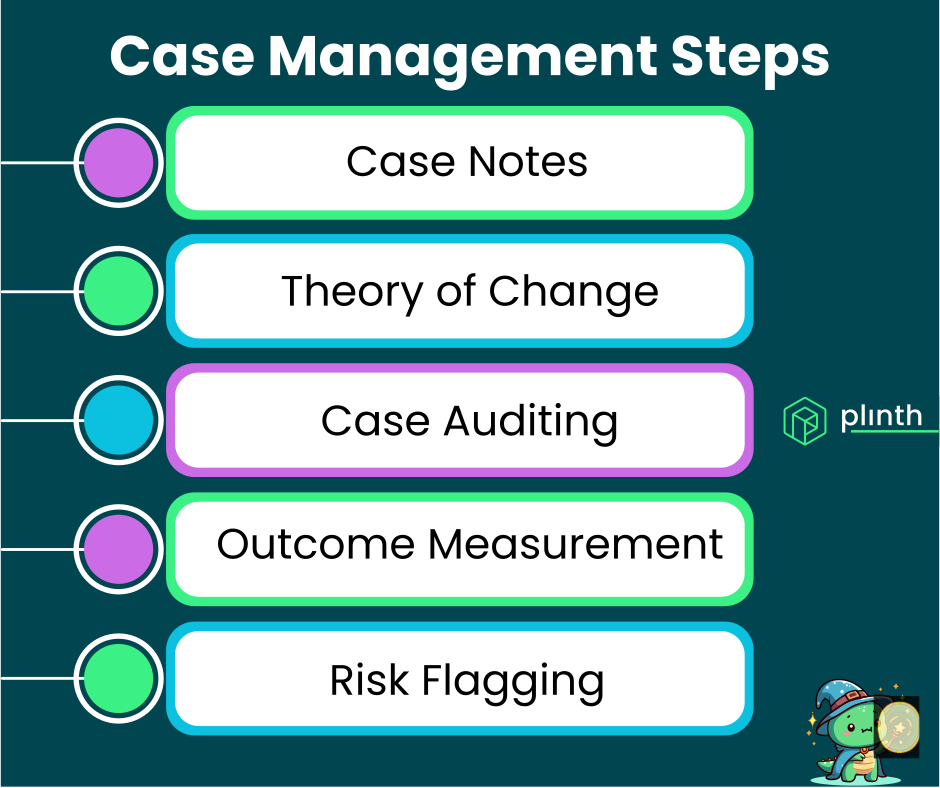
Individual beneficiary relationships require case management — tracking support interactions, progress, and outcomes over time. Plinth's case management provides this, integrated with the partner and referral management described above.
For Trustees and Internal Stakeholders: Governance Tools
Board management tools (board portals, document sharing, action tracking) help manage trustee relationships. Many charities use simple shared drives or specialist tools like Boardable or Diligent.
For the Public: Communications Platforms
Email marketing tools (Mailchimp, Campaign Monitor), social media management (Hootsuite, Buffer), and website CMS platforms manage public-facing stakeholder engagement.
The most effective charities use 3-5 specialist tools rather than one compromised generalist. The key is ensuring data flows between them where needed and that each tool is genuinely used by the team responsible for that stakeholder group.
Step 5: Track Relationship Health
You cannot manage what you do not measure. Establish simple indicators of relationship health for your most important stakeholder groups.
Relationship Health Indicators
For funders:
- Are reports submitted on time?
- Has the funder increased, maintained, or decreased funding?
- When was the last proactive conversation (not triggered by a report)?
- Has the funder introduced you to other funding opportunities?
For partner organisations:
- What percentage of referrals are responded to within the agreed timeframe?
- What is the referral acceptance rate?
- When was the last substantive conversation about the partnership?
- Is the partner actively using the shared system?
For commissioners:
- Are all performance targets being met?
- When was the last relationship meeting (not contractual reporting)?
- Has the commissioner raised any concerns?
- Are you being consulted on future commissioning plans?
For trustees:
- Is board attendance above 75%?
- Are board papers read in advance (evidenced by informed questions)?
- When was the last trustee engagement outside formal meetings?
- Are subcommittees active and effective?
Plinth's Partner CRM automatically tracks partner relationship health through referral response times, acceptance rates, and activity levels. This turns subjective relationship assessment into data-driven insight.
Step 6: Handle Difficult Relationships
Not all stakeholder relationships are straightforward. Charities frequently face tensions with funders, partners, or commissioners. Handling these well is a mark of organisational maturity.
Common Difficult Situations
A funder imposes unreasonable reporting requirements. Address this proactively by sharing the cost of compliance and suggesting proportionate alternatives. Document the conversation and any agreed changes.
A partner is unresponsive to referrals. Before escalating, check whether the issue is capacity, system access, or relationship breakdown. Offer support first; escalate only if the pattern persists. Automated reminders in Plinth help surface these issues early.
A commissioner's expectations exceed the contract. Document the original scope, the additional expectations, and the resource implications. Present this factually, not defensively. Request a formal scope review.
A trustee is disengaged or disruptive. The Chair should address this through a private conversation, referencing the trustee code of conduct. If the issue persists, follow your governance procedures for trustee removal.
Approach: In every difficult stakeholder situation, lead with curiosity rather than accusation. Ask "What's driving this?" before deciding on a response.
The Charity Governance Code expects trustees to identify and manage conflicts of interest effectively, ensuring decisions are not influenced by personal or external interests. This principle extends to how the organisation manages conflicts across all stakeholder relationships.
Step 7: Review and Adapt Annually
Stakeholder landscapes change. New funders emerge, partnerships evolve, commissioners change priorities, and trustees rotate. Review your stakeholder map and management approach at least annually.
Annual review checklist:
- Has the stakeholder map changed? Add new stakeholders, remove inactive ones
- Are relationship owners still appropriate? Reassign where roles have changed
- Are communication rhythms working? Adjust frequencies based on feedback
- Which relationships have strengthened? What worked?
- Which relationships have weakened? What can be improved?
- Are your tools still fit for purpose? Consider whether manual processes should be systematised
Build this review into your annual planning cycle, ideally alongside strategy review and budget setting.
Common Mistakes in Charity Stakeholder Management
Treating all stakeholders the same. Different stakeholders need different approaches. A quarterly report works for funders; it is too infrequent for active partners and too frequent for regulators.
Confusing communication with engagement. Sending newsletters is communication. Engagement means two-way interaction — listening, responding, adapting. The most valuable stakeholder relationships involve genuine dialogue.
Neglecting "maintenance" relationships. Charities often focus on new relationships (new funders, new partners) while neglecting existing ones. Retention is almost always more valuable than acquisition.
Relying on personal relationships rather than systems. When the partnership coordinator leaves, do the partnerships go with them? If relationships live in someone's head rather than a system, your organisation is vulnerable. A Partner CRM ensures institutional memory.
Avoiding difficult conversations. Unaddressed tensions compound. A small issue discussed early is manageable; the same issue left for six months becomes a relationship crisis.
Over-promising and under-delivering. Manage expectations honestly. Stakeholders respect honesty about limitations far more than they respect ambitious promises followed by disappointment.
Frequently Asked Questions
How do we manage stakeholder relationships with a small team?
Focus is essential. You cannot give equal attention to every stakeholder when resources are limited. Use the influence-interest matrix to prioritise ruthlessly. For partner relationships specifically, a system like Plinth automates much of the administrative burden — referral tracking, reminders, and reporting — freeing staff to focus on the relational aspects that require human attention.
Should we have a dedicated stakeholder manager?
Charities with more than 20 significant stakeholder relationships (including partners, funders, and commissioners) benefit from a dedicated role or at least a clearly defined responsibility within an existing role. For smaller charities, the CEO or operations manager typically takes this on, supported by tools that reduce the administrative load.
How do we measure the ROI of stakeholder management?
Directly attributing financial returns to relationship management is difficult. Instead, track proxy indicators: funder retention rates, referral completion rates, partnership growth, commissioner satisfaction scores, and trustee engagement levels. If these metrics improve, your stakeholder management is working.
What tools do we absolutely need?
At minimum, you need a way to store stakeholder information, track interactions, and manage deadlines. A spreadsheet can work for very small organisations. For charities with active partner networks, a Partner CRM is essential. For funder relationships, a grant management system helps. The key is choosing tools that your team will actually use consistently.
How do we balance transparency with confidentiality?
Share as much as you reasonably can with each stakeholder group. Funders should see impact data but not necessarily detailed financial breakdowns of other funders' contributions. Partners should see referral outcomes but not necessarily the details of referrals sent to other partners. Commissioners should see performance data but not necessarily your strategic discussions with trustees. Clear data governance policies help navigate this balance.
When should we escalate a relationship issue?
Escalate when: the relationship owner has attempted resolution and failed; the issue affects service delivery or beneficiaries; there is a safeguarding or compliance dimension; or the issue requires authority above the relationship owner's level. Document every escalation and its resolution.
Recommended Next Pages
The Complete Guide to Partner CRM for Nonprofits — Deep dive into managing partner organisation relationships with dedicated software.
Best CRM Software for Charities and Nonprofits in 2026 — Compare CRM options across all stakeholder types.
Partner CRM vs Salesforce for Charities — Compare purpose-built and platform approaches to partner management.
Case Management for Charities: A Beginner's Guide — Managing beneficiary relationships alongside stakeholder relationships.
Last updated: May 2026
For more information about managing stakeholder relationships with Plinth, contact our team or schedule a demo.