Top Digital Platforms for UK Charities in 2026: A Practical Guide
A comprehensive guide to the best digital platforms for UK charities in 2026, covering CRM, case management, grant management, room bookings, payments, volunteering, impact measurement, and communications. Honest comparisons and practical advice.
On this page13
Running a UK charity in 2026 means juggling more digital tools than ever. You need software to manage beneficiaries, process payments, coordinate volunteers, apply for grants, book rooms, measure impact, and communicate with supporters. Getting this right saves time, reduces errors, and strengthens funding applications. Getting it wrong means duplicated data, frustrated staff, and hours lost to workarounds.
This guide walks through eight essential platform categories, compares the leading options in each, and explains how they fit together. It is written for UK charities of all sizes, from small community organisations with a handful of staff to larger charities managing multiple programmes and venues.
TL;DR: Most UK charities need platforms across several categories. Specialist tools are often strong in one area but create data silos when you use six or seven of them together. Plinth has spent over seven years working with UK charities to build a modern, comprehensive platform that brings grant management, case management, partner CRM, room bookings, payments, surveys, volunteering, and stock tracking into a single system — with AI woven through the experience in ways that genuinely save time (not just chatbot window dressing). That integration matters most for small-to-medium charities that cannot afford to maintain and connect multiple separate tools. For specific needs like donor fundraising or enterprise-scale CRM, dedicated platforms like Beacon or Salesforce may still be the right choice.
What you will learn: Which platforms lead in each category, what they cost, where they excel, and where an integrated approach saves time and money.
Who this is for: Charity managers, trustees, operations leads, and anyone responsible for choosing or reviewing digital tools at a UK charity.
Why Platform Choice Matters for UK Charities
The 2025 Charity Digital Skills Report paints a clear picture: 69% of UK charities cite strained finances as the main barrier to digital progress, and 63% specifically struggle to fund infrastructure, systems, and tools. Only 44% have a digital strategy at all — down from 50% the previous year. Meanwhile, 68% of small charities remain in the early stages of digital adoption.
The consequences of poor platform choices are predictable: staff re-enter the same data in multiple systems, reporting takes days instead of minutes, and when a funder asks for outcome data linked to expenditure, nobody can produce it without manual work.
Choosing platforms deliberately, with an eye on how they connect, is one of the most impactful decisions a charity leadership team can make. This does not mean you need one tool for everything. It means you need a clear picture of which categories matter for your organisation and a strategy for how data flows between them.
1. CRM (Customer Relationship Management)
A CRM is the backbone of how your charity tracks relationships: donors, partners, referral agencies, local authorities, and other stakeholders. For a detailed comparison, see our full CRM guide for charities.
What to look for
- Contact and organisation records with custom fields
- Interaction tracking (calls, emails, meetings)
- Segmentation for communications and reporting
- Referral and partnership management
- GDPR compliance and consent tracking
Leading options
| Platform | Best for | Approximate cost | UK charity focus |
|---|---|---|---|
| Salesforce Nonprofit | Large charities with technical capacity | Free for up to 10 users (Power of Us), but implementation costs are significant | Moderate — powerful but requires configuration |
| Beacon | Donor-focused fundraising charities | From £32.50/month (billed annually) | Strong — built for UK fundraising |
| Donorfy | Small-to-medium fundraising charities | Free Essentials tier up to 250 constituents; Professional from £39/month +VAT | Strong — UK-built, donor-centric |
| Access Charity CRM (formerly ThankQ) | Large legacy charities and membership orgs | Quote-based, typically higher | Strong — long-established in the UK sector |
| Bitrix24 | Budget-conscious teams wanting CRM + project tools | Free tier (unlimited users); paid plans from around $61/month USD | Weak — general-purpose, not charity-specific |
| Plinth | Charities managing partner organisations and referral networks | Included in Plinth subscription | Strong — built specifically for UK charities |
Where Plinth fits
Plinth's Partner CRM takes a modern approach to organisational relationship management. Rather than retrofitting a sales pipeline tool for charity use, it is built around how charities actually work: tracking referral partners, local authorities, funders, and delivery partners, with AI-assisted insights across your network. Everything connects directly to case management, grant reporting, and service delivery data. If your main need is donor fundraising with gift aid tracking, Beacon or Donorfy are purpose-built for that.
2. Case Management
Case management software helps charities track the people they support: recording needs assessments, interventions, outcomes, and safeguarding information. For charities delivering services, this is often the most critical system. See our case management feature page for more on how Plinth approaches this.
What to look for
- Secure beneficiary records with role-based access
- Customisable assessment and outcome forms
- Safeguarding flags and alerts
- Outcome tracking linked to funder requirements
- Reporting that can be filtered by programme, funder, or time period
Leading options
| Platform | Best for | Approximate cost | UK charity focus |
|---|---|---|---|
| Lamplight | Established charities needing detailed outcome tracking | Income-based; from £180/year hosting + setup fees | Strong — widely used in the UK sector |
| Charitylog | Small-to-medium charities wanting straightforward case recording | Income-based; quote required | Strong — UK-built, practical |
| Inform | Advice and information services | Quote-based | Strong — designed for advice sector |
| Plinth | Charities wanting case management integrated with grants, CRM, and bookings | Included in Plinth subscription | Strong — built for UK charities |
Where Plinth fits
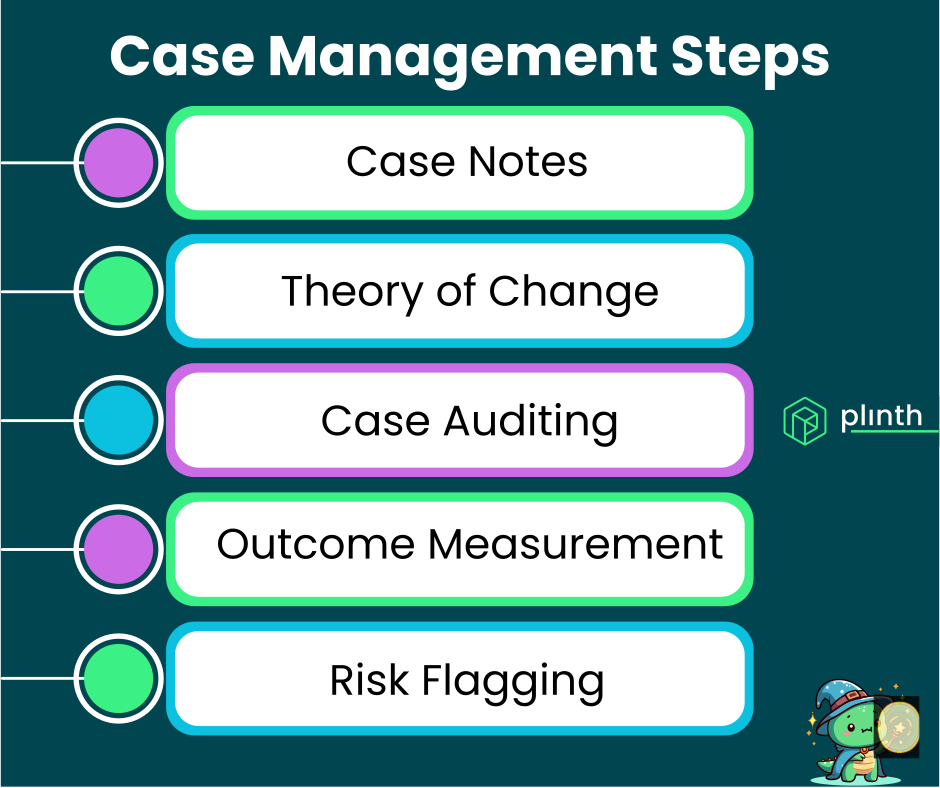
Plinth's case management is where its AI capabilities make the biggest difference to frontline teams. Automated case note generation from session recordings means practitioners spend time with people, not typing up notes afterwards. AI-powered risk flagging identifies safeguarding concerns and patterns across caseloads. Intelligent outcome tracking learns from your data and generates funder-ready reports automatically. The interface is modern and fast — designed for frontline workers who need to capture information quickly, not navigate layers of menus. Traditional case management tools like Lamplight and Charitylog offer solid record-keeping, but they lack the AI-powered automation that transforms how teams work day to day.
3. Grant Management
Grant management platforms help charities find, apply for, track, and report on grant funding. This is Plinth's core strength. For a detailed look, see our AI grant management feature page.
What to look for
- Grant discovery and eligibility matching
- Application drafting support
- Budget tracking against grant conditions
- Outcome and expenditure reporting aligned to funder requirements
- Document storage for evidence and correspondence
Leading options
| Platform | Best for | Approximate cost | UK charity focus |
|---|---|---|---|
| Blackbaud Grantmaking | Large grantmakers and charities managing complex portfolios | Quote-based, typically high | Moderate — US-origin, used by some UK organisations |
| Fluxx | Grantmakers and large charities with complex workflows | Quote-based, mid-to-high | Weak — primarily US-focused |
| SmartSimple | Large organisations needing enterprise-level grant tracking with AI screening | Quote-based, high | Moderate — North American, expanding UK presence |
| Foundant | Mid-to-large foundations (now merged with SmartSimple under L Squared Capital) | Quote-based | Moderate — North American |
| Plinth | UK charities applying for and managing grants | Included in Plinth subscription | Strong — built specifically for UK charity grant workflows |
Where Plinth fits
This is where Plinth's AI capabilities are most distinctive for UK funders. While established platforms like Blackbaud Grantmaking and Fluxx are workflow-led tools with less emphasis on UK-regulatory AI integration, Plinth uses AI for analytical work tied to UK data sources: automated due diligence checks against the Charity Commission and Companies House registers, AI-assisted application scoring against your funding criteria, risk assessment with explanations, and impact analysis that draws on monitoring data rather than just formatting it. For grantmakers, this can substantially reduce assessment time. For applicants, Plinth helps draft stronger applications and generates outcome reports by pulling real data from case management and CRM — no manual assembly required.
4. Room Bookings and Venue Hire
Many UK charities operate community spaces, meeting rooms, or event venues. Room booking software replaces paper diaries and email chains with online calendars, automated invoicing, and occupancy reporting. See our full room booking software comparison and our guide to community centre management software.
What to look for
- Online booking calendar with public and internal views
- Conditional pricing (charity rate, commercial rate, community rate)
- Recurring booking support
- Automated invoicing and payment collection
- Occupancy and revenue reporting
Leading options
| Platform | Best for | Approximate cost | UK charity focus |
|---|---|---|---|
| Hallmaster | Village halls and community centres | From around £144-180/year (single venue, +VAT) | Strong — long-established in UK community venues |
| BookingsPlus | Council-managed venues and larger facilities | Quote-based | Strong — used by UK local authorities |
| Skedda | Tech-savvy organisations wanting a modern interface | From $99/month (USD); nonprofit pricing on request | Weak — US-headquartered, general-purpose |
| Plinth | Charities that also need CRM, case management, and grant tools | Included in Plinth subscription | Strong — built for UK charities and community organisations |
Where Plinth fits
Plinth brings room bookings into a modern, integrated experience. Bookings connect to your financial reporting (room hire income alongside grant income), hirer organisations appear in your partner CRM, and availability is managed through a clean, intuitive calendar interface. AI-assisted setup helps you configure pricing tiers and booking rules quickly rather than wrestling with settings pages. If room booking is your only need and you want a simple, inexpensive standalone tool, Hallmaster is a reliable choice.
5. Payments
Charities need to collect payments for room hire, event tickets, membership fees, donations, and service charges. The right payment platform depends on what you are collecting and how. See our payment software for charities guide for a deeper comparison.
What to look for
- Low transaction fees (charity rates where available)
- Support for one-off and recurring payments
- Direct Debit capability for regular givers or members
- Integration with your booking or CRM system
- Clear reconciliation and reporting
Leading options
| Platform | Best for | Approximate cost | UK charity focus |
|---|---|---|---|
| Stripe | Online card payments, event tickets, subscriptions | 1.5% + 20p per transaction (UK cards); reduced charity rate of 1.2% + 20p available subject to eligibility | Moderate — widely used, not charity-specific |
| GoCardless | Direct Debit collection for recurring payments | From 1% + 20p per transaction | Moderate — strong for recurring payments |
| SumUp | In-person card payments at events or venues | From 1.69% per transaction; readers from £25 + VAT | Weak — general-purpose point-of-sale |
| Plinth | Payments integrated with bookings, invoicing, and reporting | Included in Plinth subscription | Strong — connected to room bookings and financial reporting |
Where Plinth fits
Plinth handles payment collection as part of its booking and invoicing workflow — no separate payment gateway to configure or reconcile against. When someone books a room or registers for a programme, payment is collected and recorded automatically. The experience is seamless and modern, closer to what people expect from consumer apps than from traditional charity software. Plinth also records donations, manages Gift Aid tracking and reclaim, and includes donor management. For high-volume public online donation pages, a dedicated fundraising platform may still be more appropriate.
6. Volunteering
Volunteers are the backbone of most UK charities. Managing them well means tracking availability, skills, DBS checks, hours, and impact. See our volunteer management software guide for a detailed comparison.
What to look for
- Volunteer profiles with skills, availability, and compliance records
- Shift scheduling and sign-up
- Hours logging and reporting
- Communication tools (email, SMS)
- DBS and safeguarding tracking
Leading options
| Platform | Best for | Approximate cost | UK charity focus |
|---|---|---|---|
| Better Impact | Large volunteer programmes with complex scheduling | Quote-based, mid-range | Moderate — Canadian-origin, used by some UK charities |
| Access Assemble | Established UK VMS used by major charities (British Red Cross, RSPCA, NHS Trusts) | Starter from £75/month for up to 250 volunteers | Strong — Access Group ownership, established UK presence |
| Three Rings | Volunteer-led organisations (helplines, befriending) | Free for small orgs (under £6.5k income); from around £174/year inc VAT | Strong — UK CIC, built by volunteers for volunteers |
| Plinth | Charities wanting volunteer tracking alongside other operations | Included in Plinth subscription | Strong — integrated with case management and CRM |
Where Plinth fits
Plinth includes volunteer management as part of its integrated platform, with a clean modern interface that volunteers themselves can navigate without training. Hours and activities connect automatically to programme reporting and impact measurement — so when a funder asks how many volunteer hours supported a particular programme, you have the answer instantly. If your volunteer programme is large and complex with hundreds of volunteers across multiple sites, a dedicated tool like Better Impact or Three Rings may offer deeper scheduling features.
7. Impact Measurement
Funders increasingly expect charities to demonstrate outcomes, not just activities. Impact measurement tools help you collect, analyse, and present evidence of the difference your work makes.
What to look for
- Outcome frameworks (Theory of Change, logic models)
- Data collection via surveys, forms, and case records
- Automated reporting and dashboards
- Ability to align with funder-specific outcome frameworks
- Export and sharing options for trustees and funders
Leading options
| Platform | Best for | Approximate cost | UK charity focus |
|---|---|---|---|
| Lamplight | Charities already using Lamplight for case management | Included with Lamplight | Strong — well-integrated outcome tracking |
| Upshot | Youth sector organisations | Quote-based | Strong — designed for UK youth work |
| Social Value Engine | Organisations needing SROI and social value calculations | Quote-based | Strong — UK social value methodology |
| Plinth | Charities wanting impact data drawn from operational systems | Included in Plinth subscription | Strong — pulls data from case management, grants, and surveys |
Where Plinth fits
This is where Plinth's integrated, AI-powered approach pays off most. Impact measurement is most useful when the data is collected as a byproduct of normal operations rather than as a separate exercise. Plinth's surveys, case management records, and programme tracking feed directly into impact dashboards and funder reports — and AI generates narrative summaries and identifies outcome patterns that would take hours to spot manually. You are not asking staff to enter data twice or compile reports from scratch. If you need specialist social value calculations (SROI, cost-benefit analysis), a dedicated tool like Social Value Engine is more appropriate.
8. Communications
Keeping in touch with supporters, beneficiaries, partners, and the public requires email marketing, newsletters, and sometimes SMS. The communications landscape is well-served by general-purpose tools, so the question is usually about integration rather than capability.
What to look for
- Email newsletter creation and sending
- Contact segmentation and list management
- Automation (welcome sequences, event reminders)
- Nonprofit pricing or free tiers
- Integration with your CRM or database
Leading options
| Platform | Best for | Approximate cost | UK charity focus |
|---|---|---|---|
| Mailchimp | General email marketing with good templates | Free for up to 250 contacts (reduced January 2026); paid from around $13/month | Weak — US-origin, general-purpose but widely used |
| Brevo (formerly Sendinblue) | Email and SMS with strong automation | Free tier available (300 emails/day); paid from around $9/month | Weak — French-origin, general-purpose |
| Action Network | Campaigning and advocacy communications | Free tier available; paid plans for larger orgs | Moderate — popular with campaigning organisations |
Where Plinth fits
Plinth is not primarily a communications platform and does not attempt to replace Mailchimp or Brevo for mass email marketing. However, contact data from Plinth's CRM and case management can be used to inform your communications segmentation. If your communications needs are straightforward (occasional newsletters, event announcements), most of the free tiers above will serve you well.
The Integration Problem: Why It All Matters
The biggest challenge for UK charities is not finding a good tool in any single category. It is making those tools work together without creating an administrative burden.
Consider a typical small charity that delivers support programmes from a community building. They might use:
- A CRM for donor relationships
- A separate case management tool for beneficiaries
- A booking platform for room hire
- A payment gateway for invoices
- Spreadsheets for grant tracking
- A survey tool for impact measurement
- An email platform for newsletters
That is seven systems, each with its own login, its own data format, and its own reporting. When a funder asks "How many beneficiaries accessed your services at your community venue last quarter, and what outcomes did they achieve?", answering that question requires pulling data from at least three of those systems and reconciling it manually.
The integrated approach
This is the problem Plinth was built to solve. Plinth has been working with UK charities and community organisations for over seven years, and from the start it was designed as a comprehensive, integrated platform — not a single-purpose tool that bolted on modules as an afterthought. Grant management, case management, CRM, bookings, payments, volunteering, surveys, and stock tracking all work together natively. AI runs through the entire experience — not as a bolt-on chatbot, but as a genuine analytical layer that automates due diligence, generates case notes, scores applications, identifies risks, and produces impact reports from your live operational data.
The result is that Plinth's individual modules are not just "good enough" compromises — they are genuinely competitive with specialist tools, and in areas like case management and grant management, the AI capabilities go well beyond what the traditional players offer. Beacon has deep high-volume individual-giving and supporter-marketing features that Plinth does not try to replicate. But for the operational work that most charities do day to day — managing cases, tracking grants, booking rooms, measuring impact — Plinth's integrated, AI-powered approach is increasingly the stronger choice.
A practical decision framework
| Your situation | Recommended approach |
|---|---|
| Small charity (1-10 staff), multiple needs | Start with an integrated platform. Add specialist tools only where the integrated option genuinely falls short. |
| Medium charity (10-50 staff), multiple programmes | An integrated platform covers most needs. Add a specialist tool only for areas where you have a genuinely unique requirement (e.g. donor fundraising at scale). |
| Large charity (50+ staff), dedicated IT capacity | Best-of-breed tools connected via integrations or middleware. Budget for ongoing technical maintenance. |
| Community centre or venue-based charity | Prioritise a platform that combines bookings, payments, and CRM. These three areas generate the most data overlap. |
Cost and Capacity Considerations
Start with what matters most
You do not need to adopt platforms across all eight categories at once. Identify the two or three areas where your current processes cause the most pain, whether that is grant reporting, room booking, or beneficiary tracking, and address those first.
Look for nonprofit pricing
Many platforms offer reduced rates for registered charities. Salesforce provides up to 10 free licences through its Power of Us programme (though implementation costs remain significant). Three Rings is free for organisations with income under £6,500. Mailchimp and Brevo offer free tiers that suit many small charities. Lamplight and Charitylog use income-based pricing that scales to smaller organisations. Always ask about charity pricing even when it is not advertised.
Budget for adoption, not just subscription
The cost of a platform is not just the monthly fee. Factor in time for data migration, staff training, and the inevitable dip in productivity during the transition period. Simple tools that your team will actually use beat powerful tools that sit unused because they are too complex.
Data portability matters
Before committing to any platform, check that you can export your data in a standard format (CSV at minimum). Charity needs change, and you should never be locked into a tool because leaving would mean losing your data.
Frequently Asked Questions
Do we need separate tools for CRM and case management?
It depends on what you mean by each. If "CRM" means tracking donor relationships for fundraising, and "case management" means recording beneficiary support, then yes, these are different functions and some charities use separate tools for each. However, platforms like Plinth combine partner CRM and case management in a single system, which works well when your CRM needs are focused on organisations rather than individual donors.
How do we avoid data duplication across systems?
Designate a "single source of truth" for each type of data. For example, beneficiary records live in your case management system, donor records live in your fundraising CRM, and booking data lives in your room booking tool. If two systems need the same data, decide which one is authoritative and treat the other as a read-only copy. Integrated platforms reduce this problem by holding multiple data types in one place.
Can very small charities afford these tools?
Yes. Many platforms offer free tiers or charity discounts that bring costs within reach. Three Rings is free for small volunteer organisations. Mailchimp and Brevo have free tiers. Plinth is priced for the charity sector. The real cost risk for small charities is not subscription fees but staff time spent maintaining too many disconnected systems.
Should we build our own tools using spreadsheets and free software?
Spreadsheets are fine for simple needs, and there is no shame in using them. But they become a liability when multiple people need to access and update the same data, when you need audit trails for safeguarding, or when funders expect structured outcome reports. If you are spending more time maintaining your spreadsheet system than the work it supports, it is time to consider a dedicated platform.
How do we manage the transition from our current tools?
Plan for a transition period rather than a hard switch. Run old and new systems in parallel for a defined period (typically one to three months). Migrate historical data where it is practical and valuable, but do not let the perfect be the enemy of the good. Sometimes a clean start with a new system is better than importing years of inconsistent legacy data.
Is Plinth the right choice for every charity?
No. Plinth is strongest for charities that need several of its modules working together: grant management, case management, CRM, bookings, payments, and volunteering. It is a modern, fast-growing platform with AI capabilities that are distinctly different from many of the established players in the sector. But if your charity has one dominant need — say large-scale donor fundraising or enterprise CRM — a specialist tool in that area may serve you better. The honest answer is that the best platform depends on your specific combination of needs, team size, and budget.
Recommended Next Pages
- Best CRM Software for Charities — detailed comparison of six CRM platforms for UK charities
- Room Booking Software for Charities — in-depth look at booking tools for community venues
- Volunteer Management Software — guide to platforms for coordinating charity volunteers
- Payment Software for Charities — comparison of payment processing options
- Community Centre Management Software — all-in-one guide for venue-based organisations
- AI Grant Management — how Plinth uses AI to strengthen grant applications
- Case Management — Plinth's approach to beneficiary tracking and outcome recording
- Partner CRM — managing organisational relationships and referral networks
Last updated: May 2026
Plinth has been working with UK charities for over seven years, building a modern, AI-powered platform that brings grant management, case management, CRM, bookings, payments, volunteering, and impact measurement into a single system. Book a demo to see it in action, or get in touch to discuss what would work best for your organisation.