What Are AI Case Notes? How Speech-to-Text Is Transforming Case Work
A comprehensive guide to AI case notes for charities and social workers, explaining how speech-to-text transcription and AI structuring are reducing admin burden, improving documentation quality, and giving case workers more time for direct support.
On this page7
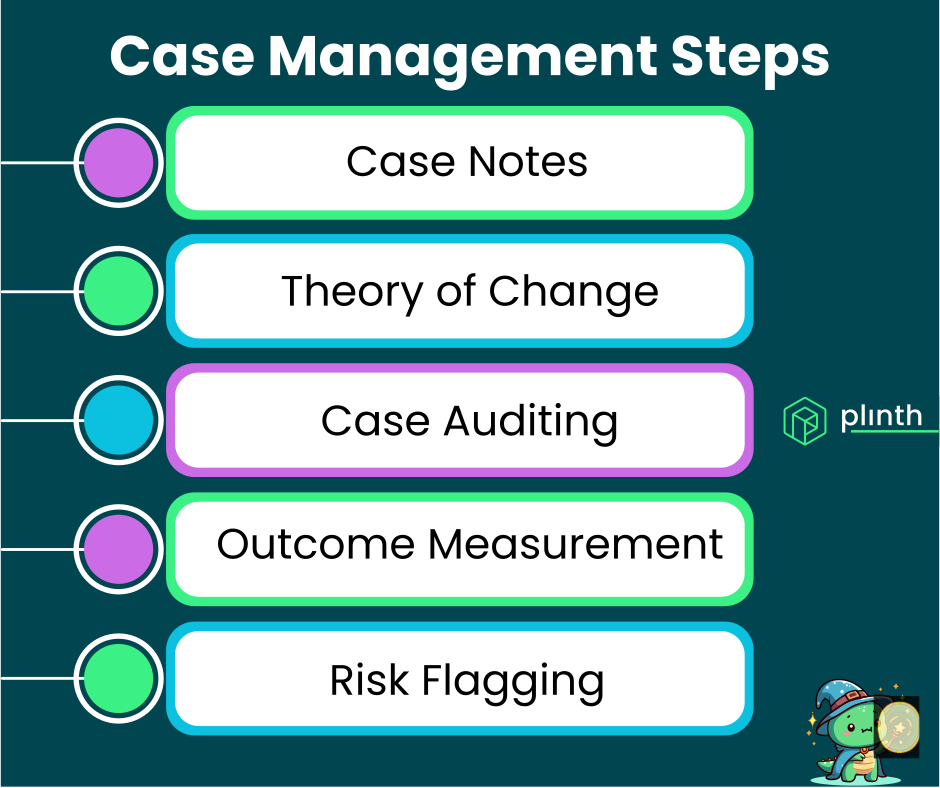
AI case notes use speech-to-text transcription and artificial intelligence to transform recorded conversations into structured, professional case documentation. Instead of spending 30–60 minutes writing up notes after every meeting, case workers record the conversation (with consent), and AI generates structured notes within minutes — complete with speaker identification, key concerns flagged, and follow-up actions extracted.
TL;DR: AI case notes use speech recognition to transcribe conversations in real time, then apply AI to generate structured case documentation automatically. This reduces the time case workers spend on documentation by 50–70%, improves note accuracy and completeness, and frees staff for direct support work. The technology works on mobile phones, including offline, making it practical for community-based work.
What you'll learn: How AI case notes work, what they can and cannot do, and how they are transforming documentation practices in charities, social work, and housing associations.
Why it matters: Case workers in the UK spend a majority of their time on administrative tasks — BASW research found social workers spend roughly 64% of their working week on computer-based and paperwork tasks, with documentation being the single largest component. AI case notes address this directly.
Getting started: Practical considerations for adopting AI case notes in your organisation.
Who this is for: Social workers, case managers, charity leaders, and IT decision-makers exploring AI-assisted documentation.
How AI Case Notes Work
AI case notes combine two technologies — speech-to-text transcription and large language model (LLM) processing — to convert spoken conversations into written, structured documentation.
Step 1: Recording the Conversation
The case worker records the conversation using their phone or another device. With Plinth's AI case notes, this happens through a mobile-friendly interface that works in the field.
Consent: The case worker obtains informed consent from the individual before recording. This is a professional and ethical requirement, and the system should support clear consent workflows.
Real-Time Transcription: As the conversation progresses, AI transcribes the speech in real time, converting audio to text with speaker identification (diarisation) that distinguishes between participants.
Offline Capability: For community-based work in areas with poor connectivity, the recording can happen offline. The audio is processed when connectivity is restored.
Quality: Modern speech-to-text engines achieve accuracy rates of 90–95% in clear conditions, with specialised models trained on conversational speech performing even better. Background noise, strong accents, and overlapping speech reduce accuracy but are handled increasingly well by current models.
The recording process adds no overhead to the conversation itself — the case worker focuses on the individual, not on taking notes.
Step 2: AI Processing and Structuring
Once the conversation is transcribed, AI analyses the full text and generates structured case notes.
Speaker Identification: The AI identifies who said what, labelling contributions from the case worker and the individual (and any other participants) separately.
Key Concerns: The AI identifies and flags concerns raised during the conversation — for example, mentions of financial difficulty, health issues, housing problems, safeguarding indicators, or emotional distress.
Follow-Up Actions: The AI extracts any commitments, referrals, or next steps discussed during the conversation and lists them as follow-up actions with suggested deadlines.
Structured Format: The raw transcription is reorganised into a professional case note format with sections for context, discussion summary, concerns identified, and actions agreed.
Summary Generation: A concise summary is produced that captures the essential content of the conversation in a few paragraphs, suitable for quick review by supervisors or colleagues.
AI processing typically takes 1–3 minutes after the conversation ends, depending on length. A 30-minute conversation generates structured notes in under 2 minutes.
Step 3: Review and Approval
AI case notes are generated as drafts for the case worker to review, edit if needed, and approve before they become part of the case record.
Human in the Loop: The case worker always reviews AI-generated notes before they are saved. This is essential for accuracy, professional accountability, and maintaining the case worker's judgment as the authoritative source.
Edit Capability: Case workers can correct any transcription errors, add context the AI could not infer, adjust emphasis, or remove sensitive content that should not be in the record.
Approval Workflow: Once reviewed, the case worker approves the notes, which are then linked to the case record in the case management system.
Time Saving: Even with review and editing, the total time from conversation to completed notes is typically 5–10 minutes, compared with 30–60 minutes for manual note-writing.
The review step ensures professional standards while preserving the massive time savings that AI provides.
The Problem AI Case Notes Solve
To understand why AI case notes matter, you need to understand the documentation burden facing case workers across the UK.
The Admin Burden
Research consistently shows that front-line support workers spend a disproportionate amount of their time on administrative tasks rather than direct work with the people they support.
Majority on Administration: Studies by organisations including the British Association of Social Workers (BASW) have found that social workers spend roughly 64% of their working week on computer-based and paperwork tasks, with documentation being the single largest component.
Roughly 24% Direct Contact: The same research suggests that only roughly 24% of a case worker's time is spent on direct face-to-face work with individuals they support.
Backlog Effect: When documentation falls behind, case workers face growing backlogs that create stress, reduce accuracy (notes written days later are less reliable), and further reduce time for direct work.
Recruitment and Retention Impact: Administrative burden is consistently cited as one of the top three reasons social workers and support workers consider leaving the profession. With vacancy rates in children's social work reaching approximately 17% in England, reducing admin burden is a workforce retention strategy.
AI case notes directly address the largest single component of the admin burden — writing up conversations.
Quality Problems with Manual Notes
Beyond the time cost, manual note-writing has inherent quality limitations.
Memory Decay: Notes written hours or days after a conversation inevitably lose detail. Research on memory decay shows that details of conversations are lost rapidly — particularly specific wording, figures, and sequences of events. Notes written within an hour of a conversation are significantly more complete and accurate than those written the next day.
Selective Recording: Under time pressure, case workers prioritise what they remember or consider most important, potentially missing details that turn out to be significant later.
Inconsistency: Different case workers document to different standards, making it difficult to aggregate data or ensure consistent quality across a team.
Interpretation Bias: Manual notes are filtered through the writer's perspective and interpretation, which may differ from what was actually said.
AI case notes capture the full conversation accurately, removing the quality problems caused by human memory limitations and time pressure.
What AI Case Notes Can and Cannot Do
Setting realistic expectations is important for successful adoption.
What AI Case Notes Do Well
Accurate Transcription: Capture the actual words spoken, providing a reliable record that does not depend on memory.
Consistent Structure: Every note follows the same professional format, regardless of which case worker conducted the conversation.
Comprehensive Capture: Nothing is missed or forgotten because the entire conversation is recorded and processed.
Speed: Reduce documentation time by 50–70%, giving case workers significantly more time for direct support.
Action Extraction: Automatically identify and list follow-up actions, reducing the risk of commitments being forgotten.
Concern Flagging: Highlight potential safeguarding concerns, risk indicators, or emerging needs that might be overlooked in manual notes.
Searchability: Transcribed and structured notes are fully searchable, making it easy to find specific information across a caseload.
What AI Case Notes Cannot Do
Replace Professional Judgement: AI can flag concerns but cannot assess risk, make safeguarding decisions, or determine appropriate interventions. These require human expertise.
Understand Unspoken Context: AI processes what was said. It cannot capture body language, emotional atmosphere, environmental observations, or the case worker's instinctive sense that something is not right. Case workers should add these observations during the review step.
Guarantee Perfect Accuracy: Transcription accuracy is high but not 100%. Names, specialist terminology, and speech in noisy environments may be transcribed incorrectly. The review step catches these errors.
Work Without Consent: AI case notes require the individual's informed consent to record the conversation. If consent is not given or is withdrawn, manual notes remain necessary.
Replace Documentation Training: Case workers still need to understand what makes good documentation, even though AI handles the mechanical writing. They need to know what to add, what to edit, and what professional standards to apply.
AI case notes are a powerful tool that enhances professional practice — they do not replace the need for skilled, thoughtful case workers.
Practical Considerations for Adoption
Consent and Ethics
Recording conversations raises important ethical considerations that must be addressed before implementation.
Informed Consent: Explain clearly to individuals what recording means, how their data will be processed, who will have access, and how long it will be retained. Consent must be freely given and can be withdrawn at any time.
Power Dynamics: Be sensitive to the power dynamics in support relationships. Individuals may feel pressured to consent even if uncomfortable. Offer genuine alternatives (manual notes) without disadvantage.
Data Protection: AI case notes involve processing personal data and potentially special category data (health, ethnicity). Ensure your data protection impact assessment covers AI transcription and processing. Under UK GDPR, you need a lawful basis for processing and appropriate safeguards.
Organisational Policy: Develop clear policies covering when recording is appropriate, how consent is obtained and recorded, data retention, and staff responsibilities.
Getting the ethical framework right before implementation builds trust with both staff and the individuals you support.
Technology Requirements
AI case notes are designed to be simple to use with minimal technical requirements.
Device: A smartphone is sufficient for recording and basic review. A tablet or laptop can be used for more detailed editing.
Connectivity: Real-time transcription requires an internet connection, but recording can happen offline with processing deferred until connectivity is available.
Audio Quality: A quiet environment produces the best results. Background noise, multiple simultaneous speakers, and very soft speech reduce transcription accuracy. Simple measures like moving to a quieter space significantly improve quality.
Integration: AI case notes should integrate with your case management system so that approved notes are automatically linked to the relevant case record.
The technology barrier is low — any organisation with smartphones and internet access can adopt AI case notes.
Change Management
Introducing AI case notes involves changing established work practices, which requires thoughtful change management.
Address Concerns: Staff may worry about surveillance, job security, or technology replacing human skill. Address these concerns openly and honestly.
Pilot First: Start with a small group of willing early adopters who can test the technology, provide feedback, and advocate to colleagues.
Demonstrate Benefit: Show staff the time savings in concrete terms — if each case worker saves 10 hours per week on documentation, that is 10 hours more for direct support.
Training: Provide practical training on recording, reviewing, and editing AI-generated notes. Focus on when and how to add human observations that AI cannot capture.
Ongoing Support: Make support available for questions and problems, especially in the first few weeks.
Successful adoption depends on staff experiencing the benefits firsthand, not just being told about them.
The Impact on Practice
More Time for Direct Work
The most immediate and significant impact of AI case notes is the reallocation of time from documentation to direct support.
Conservative Estimate: If AI saves 50% of documentation time, and documentation accounts for roughly 30% of a working week, the saving is approximately 6 hours per week per worker.
Practical Impact: Those 6 hours translate into additional home visits, longer conversations, better relationship-building, and more responsive support.
Caseload Implications: With less time consumed by documentation, case workers may be able to manage larger caseloads without sacrificing quality — or maintain current caseloads with significantly better support depth.
For many organisations, AI case notes represent the single biggest available improvement in front-line productivity.
Better Documentation Quality
Counter-intuitively, automating documentation often improves its quality.
Completeness: Nothing is forgotten because the full conversation is captured.
Timeliness: Notes are generated immediately rather than written up hours or days later.
Consistency: Every note follows the same structure and standards.
Searchability: Structured, text-based notes are easily searchable across entire caseloads.
Audit Trail: The original transcription provides an audit trail that manual notes cannot match.
Better documentation supports better supervision, safer practice, and stronger evidence for impact reporting.
Improved Supervision
AI case notes give supervisors better material to work with during case reviews.
Summary Access: Supervisors can quickly review AI-generated summaries of recent interactions rather than reading through detailed notes.
Concern Alerts: AI-flagged concerns provide an additional safety net, highlighting issues that might be discussed in supervision.
Pattern Recognition: Searchable, structured notes make it easier to identify patterns across cases or over time.
Preparation Time: Both supervisors and case workers spend less time preparing for supervision and more time in productive discussion.
AI case notes enhance the supervision relationship rather than replacing it.
Frequently Asked Questions
Are AI case notes accurate enough to rely on?
Modern speech-to-text engines achieve 90–95% accuracy in typical conditions. Specialised models trained on conversational speech in professional contexts can exceed this. The key safeguard is the human review step — case workers always check and approve AI-generated notes before they become part of the record. In practice, most edits are minor corrections to names, specialist terms, or occasional mis-transcriptions. The overall record is typically more accurate than manual notes written from memory.
What if the person does not consent to recording?
If an individual does not consent to recording, the case worker takes manual notes as they would without AI. AI case notes should always be offered as an option, never imposed. Some individuals may consent to recording but not to AI processing, in which case you may be able to provide a human transcription service instead, depending on your resources and policies.
How does this work with safeguarding?
AI case notes support safeguarding by creating more complete and accurate records of conversations. If safeguarding concerns are raised during a conversation, the AI flags these in the structured notes. The transcription provides an accurate record of what was said, which can be valuable evidence. However, safeguarding decisions always remain with trained professionals — AI flags concerns but does not assess them. Ensure your safeguarding policies are updated to address recorded conversations and AI-processed notes.
What about data security?
AI case notes involve processing sensitive personal data, so security is critical. Look for providers that offer: encryption of audio and text data in transit and at rest; processing within UK or EU data centres to comply with GDPR; role-based access controls; audit logging; and data retention policies that enable deletion when no longer needed. Plinth is designed with these security requirements built in.
How much does AI case note technology cost?
Costs vary by provider and scale. As part of an integrated case management platform, AI case notes are typically included in the subscription rather than charged separately. The cost should be evaluated against the time savings — if each case worker saves 10+ hours per week, the productivity gain far exceeds the technology cost. For a team of 10 case workers, the time saved equates to 2–3 additional full-time equivalent staff in direct support capacity.
Can AI case notes work in languages other than English?
Many modern speech-to-text engines support multiple languages, including Welsh, and some support real-time translation. However, accuracy varies by language, and less widely spoken languages may have lower accuracy rates. Check with your provider about support for the specific languages your communities use. Conversations that switch between languages (code-switching) present additional challenges that are being addressed by ongoing improvements in AI language models.
Recommended Next Pages
AI Case Notes vs Manual Note-Taking: Which Is Better for Charities? – A detailed comparison of AI and manual approaches to case documentation.
The Complete Guide to AI Transcription for Charities and Social Workers – Broader coverage of AI transcription technology and applications.
How to Write Effective Case Notes: Best Practices for Support Workers – Documentation standards that apply whether using AI or writing manually.
AI Case Notes Feature – How Plinth's AI case notes work in practice.
Case Management for Charities – The broader case management context for AI case notes.
Last updated: February 2026
For more information about AI case notes, contact our team or schedule a demo.