AI Case Notes vs Manual Note-Taking: Which Is Better for Charities?
A thorough comparison of AI-generated case notes and traditional manual note-taking for charities, social workers, and support organisations, covering accuracy, speed, cost, compliance, and practical implementation.
On this page10
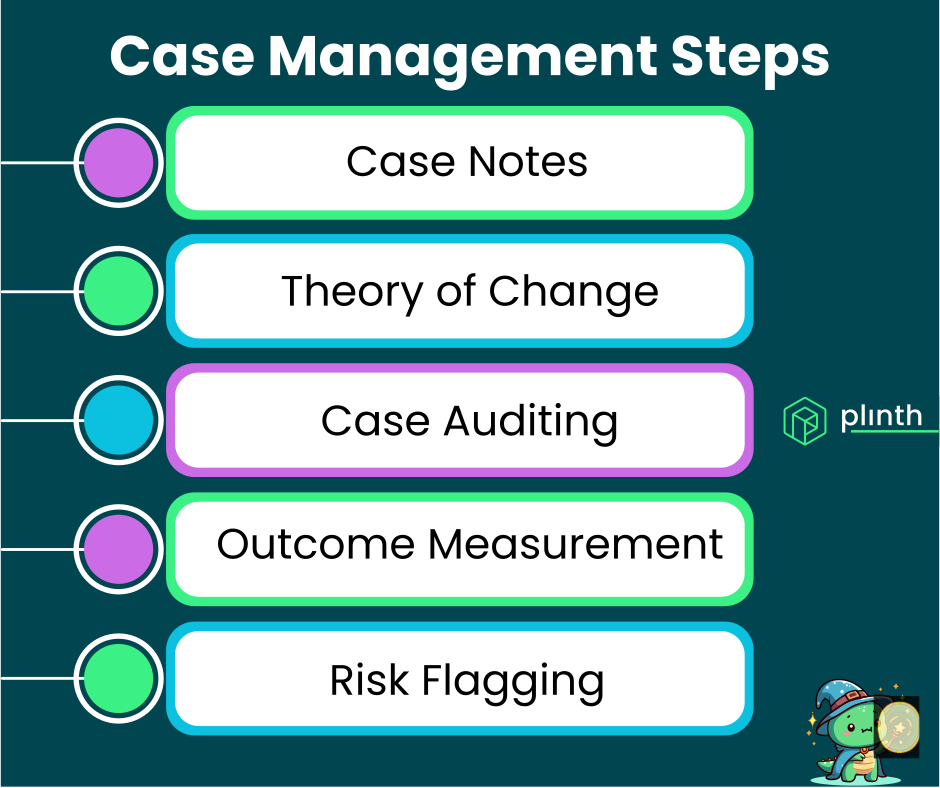
Case documentation is essential but time-consuming. Charities and support organisations face a constant tension between thorough documentation and direct service delivery. AI case notes — where conversations are recorded and AI generates structured notes — offer a fundamentally different approach to manual note-writing. This comparison helps you understand the strengths and limitations of each method so you can make the right choice for your organisation.
TL;DR: AI case notes are faster (50–70% time saving), more complete (capture the full conversation), and more consistent than manual notes. Manual notes retain advantages in settings where recording is inappropriate and for capturing non-verbal observations. The best approach for most charities is AI case notes as the default method, with manual notes as a complement and fallback.
What you'll learn: A detailed, evidence-based comparison of AI and manual case documentation across every dimension that matters.
Who this is for: Case workers, team leads, and charity managers weighing up whether to adopt AI note-taking.
Head-to-Head Comparison
The following comparison covers the dimensions most important to charities and support organisations.
| Dimension | AI Case Notes | Manual Notes |
|---|---|---|
| Time per note | 5–10 minutes (including review) | 30–60 minutes |
| Completeness | Full conversation captured | Limited by memory and time |
| Accuracy | 90–95% transcription accuracy + review | Dependent on memory; degrades rapidly |
| Consistency | Standardised format every time | Varies by individual worker |
| Timeliness | Generated immediately | Often delayed hours or days |
| Non-verbal capture | Requires manual addition | Can be included naturally |
| Consent required | Yes (for recording) | No (for note-writing) |
| Offline capability | Recording works offline; processing when connected | Fully offline |
| Cost | Software subscription | Staff time (significant hidden cost) |
| Searchability | Fully searchable text | Variable; depends on format |
| Audit trail | Original transcription available | No source beyond the notes |
Each method has genuine strengths — the comparison is not straightforward, though AI case notes have clear advantages in most dimensions.
Speed and Efficiency
AI Case Notes
The most dramatic advantage of AI case notes is speed. A 30-minute conversation generates structured notes in approximately 2 minutes of AI processing time. The case worker then spends 3–8 minutes reviewing and editing.
Total Time Per Note: 5–10 minutes from conversation end to approved case note.
Weekly Saving: For a case worker conducting 15–20 conversations per week, AI case notes save approximately 8–15 hours of documentation time.
Annual Impact: Across a team of 10 case workers, this equates to approximately 4,000–7,500 hours per year — equivalent to 2–4 additional full-time staff in direct support capacity.
The time saving is not marginal — it is transformational for front-line capacity.
Manual Notes
Manual note-writing is the traditional approach and remains the default in most organisations.
Total Time Per Note: 30–60 minutes for a thorough write-up of a 30-minute conversation.
Backlog Risk: When case workers are busy, documentation often falls behind. Delayed note-writing is common across the sector, with many practitioners writing up conversations the following day or later due to back-to-back appointments.
Compressed Notes: Under time pressure, case workers write shorter, less detailed notes, losing information that may be important later.
Manual notes are slower not because case workers are inefficient, but because translating a conversation into structured written documentation is inherently time-consuming.
Verdict: Speed
AI case notes are clearly faster. The time saving — 50–70% per note — compounds across a caseload to create substantial additional capacity for direct work. For an average charity with 10 support workers, that is the equivalent productivity of hiring 2–3 additional staff.
Accuracy and Completeness
AI Case Notes
AI case notes capture the entire spoken conversation, providing a comprehensive record that does not depend on human memory.
Full Capture: Every word spoken is transcribed, ensuring nothing is lost or forgotten.
Immediate Processing: Notes are generated while the conversation is fresh, eliminating the memory decay that affects manual notes.
Transcription Accuracy: Modern speech-to-text engines achieve 90–95% word-level accuracy in clear conditions. Accuracy improves with good audio quality and falls with background noise, strong accents, or overlapping speech.
Error Types: AI transcription errors are typically phonetic substitutions (words that sound similar) or name mis-spellings. These are usually easy to spot and correct during review.
Limitation: AI captures what was said but cannot capture what was observed — facial expressions, body language, the condition of the home environment, or the case worker's instinctive assessment. These must be added manually during review.
Manual Notes
Manual notes are filtered through the case worker's memory, interpretation, and writing ability.
Memory Limitations: Research on memory decay shows that details of conversations are lost rapidly — particularly specific wording, figures, and sequences of events. Notes written within an hour of a conversation are significantly more complete and accurate than those written the next day.
Selective Recording: Case workers unconsciously prioritise certain information based on their professional training, personal biases, and immediate concerns. Important details may be omitted because they did not seem significant at the time.
Interpretation Layer: Manual notes often blend what was said with the case worker's interpretation of what was meant. While professional interpretation is valuable, it is better recorded separately from the factual record.
Strengths: Experienced case workers are skilled at identifying and documenting the most relevant information. Manual notes can include non-verbal observations and professional assessments naturally.
Verdict: Accuracy and Completeness
AI case notes are more complete and more accurate for recording what was actually said. Manual notes are better for recording non-verbal observations and professional assessments. The optimal approach combines both: AI captures the conversation accurately, and the case worker adds observational notes during review.
Consistency and Standards
AI Case Notes
Every AI-generated note follows the same structure, uses the same format, and applies the same standards.
Standardised Output: Regardless of which case worker records the conversation, the AI produces notes in a consistent format with the same sections and structure.
Concern Flagging: AI applies consistent criteria for flagging concerns, ensuring that indicators are not missed due to individual variation in awareness or attention.
Organisational Standards: The note template and AI processing can be configured to match your organisation's documentation standards.
Audit-Ready: Consistent formatting and the availability of the original transcription make AI case notes inherently audit-friendly.
Manual Notes
Quality and consistency of manual notes vary significantly between individuals and over time.
Individual Variation: Some case workers write detailed, well-structured notes; others write brief, fragmented entries. Quality of case recordings varies significantly between practitioners — Ofsted inspections consistently highlight inconsistent recording standards as a sector-wide challenge.
Fatigue Effects: The quality of manual notes often declines over the course of a day or week as case workers become tired or pressed for time.
Training Dependency: Consistent quality requires ongoing training and supervision, which is resource-intensive to maintain.
Improvement Potential: With investment in training and supervision, manual note quality can improve — but it requires sustained organisational effort.
Verdict: Consistency
AI case notes deliver significantly higher consistency. This matters not just for individual records but for organisational data quality, impact reporting, and the ability to aggregate information across cases and teams. Manual notes can achieve good consistency with substantial investment in training and supervision, but the baseline variation is much higher.
Cost Analysis
AI Case Notes
The direct cost of AI case notes is the software subscription that includes the feature.
Software Cost: As part of an integrated case management platform like Plinth, AI case notes are typically included in the subscription, adding marginal cost to the overall platform fee.
Staff Time Saved: The primary financial benefit is the value of staff time freed from documentation. A case worker earning £30,000 per year who saves 8 hours per week through AI notes recovers approximately £6,400 in productive time annually.
Team Impact: For a team of 10 case workers, the annual value of time saved exceeds £64,000 — many times the cost of the software.
Manual Notes
Manual notes have no software cost but carry a significant hidden cost in staff time.
Staff Time Cost: A case worker spending 15 hours per week on documentation at a salary of £30,000 per year is spending approximately £12,000 of their annual salary on writing notes.
Opportunity Cost: That 15 hours per week is time not spent with individuals who need support. If the organisation needs to hire additional staff to compensate, the true cost multiplies.
Quality Cost: Poor or incomplete notes can lead to safeguarding failures, missed follow-up, and inability to demonstrate impact — each of which has real costs.
Verdict: Cost
AI case notes cost less than manual notes when total costs (including staff time) are considered. The software cost is modest compared with the productivity gain. For most charities, the return on investment is achieved within the first few months of adoption.
Compliance and Legal Considerations
AI Case Notes
Recording conversations introduces specific compliance requirements.
Consent: Recording requires informed consent from all participants. This must be obtained and documented before recording begins.
Data Protection: AI processing of recorded conversations involves processing personal data under UK GDPR. A data protection impact assessment (DPIA) should be completed before implementation.
Data Security: Audio recordings and transcriptions must be stored securely, with appropriate encryption, access controls, and retention policies.
Subject Access: Individuals have the right to access data held about them, including transcriptions. Ensure your system can fulfil subject access requests.
Regulatory Acceptance: Regulators including Ofsted and the Care Quality Commission have not prohibited AI-generated case notes, but expect appropriate quality assurance and human oversight.
Manual Notes
Manual notes have fewer compliance complications but are not compliance-free.
Data Protection: Manual notes containing personal data are subject to the same UK GDPR requirements as any other personal data processing.
Subject Access: Individuals can request access to their manual case notes, which may be harder to locate and compile than structured digital records.
Retention: Manual notes must be retained and eventually destroyed in accordance with retention policies, which is more difficult to manage with paper records.
Quality Risk: Poor-quality manual notes may not meet regulatory expectations for documentation standards, creating compliance risk of a different kind.
Verdict: Compliance
AI case notes require more upfront compliance work (consent processes, DPIA, security configuration) but produce better ongoing compliance outcomes (consistent quality, easy retrieval, clear audit trail). Manual notes are simpler to start but harder to manage at scale and more vulnerable to quality-related compliance issues.
Practical Scenarios
When AI Case Notes Work Best
Structured Support Sessions: One-to-one meetings, assessments, reviews, and support conversations — the core of case work.
Community-Based Work: Mobile recording is particularly valuable for home visits and outreach, where taking detailed notes by hand is impractical.
High-Volume Teams: Teams with large caseloads benefit most from the time savings.
Impact-Focused Organisations: When you need comprehensive outcome data for funder reporting, the completeness of AI notes is invaluable.
When Manual Notes Are Still Needed
Sensitive Situations: Some conversations are too sensitive for recording — crisis interventions, safeguarding disclosures where recording might inhibit the individual, or situations where consent cannot be meaningfully obtained.
Group Settings: Recording group sessions raises consent complexity; manual notes or anonymised summaries may be more appropriate.
Quick Interactions: A brief phone call or corridor conversation may not justify recording setup; a quick manual note is more practical.
No Consent: When an individual declines recording, manual notes are the only option.
The Recommended Approach
For most charities, the optimal approach is:
- AI case notes as the default for all structured support conversations where consent is obtained.
- Manual notes as a complement for adding non-verbal observations and professional assessments to AI-generated notes.
- Manual notes as a fallback for situations where recording is not appropriate or consent is not given.
This combined approach maximises the benefits of both methods while mitigating each other's limitations.
Transition Considerations
Moving from Manual to AI
Transitioning from manual to AI case notes requires thoughtful planning.
Pilot Group: Start with 3–5 willing case workers who can test the technology and provide feedback.
Parallel Period: Run AI and manual notes in parallel briefly so staff can compare quality and build confidence.
Training Focus: Train staff on recording technique (positioning the device, managing audio quality), consent processes, and reviewing/editing AI output.
Quick Wins: Most staff experience the benefit immediately — the first time they see a 30-minute conversation transformed into structured notes in under 5 minutes, adoption resistance typically disappears.
Ongoing Support: Provide support for the first month as staff develop new workflows and encounter edge cases.
Common Concerns
"Will it replace case workers?" No. AI case notes automate documentation, not professional judgement, relationship-building, or direct support. They make case workers more effective by freeing time for the work that matters.
"What about confidentiality?" With appropriate consent processes, data protection measures, and security controls, AI case notes can be more confidential than paper notes (which can be lost, stolen, or left visible). Choose providers with robust security credentials.
"What if the transcription is wrong?" The review step catches errors. Transcription errors are typically minor and easy to spot. The resulting notes are still more accurate than memory-based manual notes written hours later.
Frequently Asked Questions
How accurate is AI transcription for case notes?
Modern speech-to-text engines achieve 90–95% word-level accuracy in clear recording conditions. Accuracy is higher for clear speech in quiet environments and lower for noisy settings, strong regional accents, or technical vocabulary. The human review step catches remaining errors. In practice, AI-transcribed notes are typically more accurate than manually written notes because they capture the full conversation rather than relying on memory.
Do individuals mind being recorded?
Most people are comfortable with recording when the purpose and consent process are explained clearly. Research on patient-recorded consultations in healthcare settings consistently finds that recipients value recordings for recall and follow-up when informed consent is obtained. Some individuals will decline, and this must always be respected without consequence. Having a clear, respectful consent process is key.
Can AI case notes be used as evidence?
AI-generated case notes, reviewed and approved by a professional, can serve as evidence in the same way as any other professional documentation. The original transcription may provide additional evidential value as it captures the actual words spoken. Legal and regulatory acceptance of AI-generated notes is growing, though it is advisable to check with your legal adviser regarding specific regulatory contexts such as court proceedings or safeguarding inquiries.
What happens to the audio recording?
This depends on your data retention policy. Some organisations retain audio recordings for a defined period as a backup or audit trail; others delete them once the case worker has approved the written notes. Your data protection impact assessment should determine the appropriate approach, balancing the value of retaining recordings against data minimisation principles.
How do AI case notes handle multiple languages?
Many speech-to-text engines support multiple languages, and some support real-time translation. However, accuracy varies by language — major European languages typically achieve accuracy similar to English, while less widely spoken languages may have lower accuracy. Conversations that switch between languages (common in multilingual communities) present additional challenges. Check with your provider about specific language support for your communities.
Are AI case notes suitable for safeguarding documentation?
AI case notes can and do support safeguarding documentation by creating more complete and accurate records. Flagged concerns provide an additional layer of vigilance. However, safeguarding assessments and decisions must always be made by trained professionals — AI identifies potential indicators but does not assess risk or determine action. Ensure your safeguarding policies address the use of recorded conversations and AI-processed notes, and confirm that your approach is accepted by relevant regulatory bodies.
Recommended Next Pages
What Are AI Case Notes? How Speech-to-Text Is Transforming Case Work – Detailed explanation of how AI case notes work.
The Complete Guide to AI Transcription for Charities and Social Workers – Broader coverage of AI transcription technology and applications.
How to Write Effective Case Notes: Best Practices for Support Workers – Documentation standards that apply whether using AI or writing manually.
AI Case Notes Feature – How Plinth's AI case notes work in practice.
Case Management for Charities – The broader case management context.
Last updated: February 2026
For more information about AI case notes, contact our team or schedule a demo.